Pam Hawley Marlin November 2025
It was at Albion House, located on New Oxford Street in London, where, under one roof, husband, wife, and mistress now crossed paths in stairwells and shared spaces, the strain of such proximity weighing heavily on Crippen. It is tempting to imagine that within these walls, where personal and professional lives collided so uncomfortably, the first dark thoughts of ridding himself of his wife began to take shape.
More than a century after Hawley Harvey Crippen was hanged for the murder of his wife, Cora Turner Crippen (also known as Belle Elmore), I found myself wandering London's Regent Street as the city buzzed with preparations for King Charles III’s coronation. With so much history unfolding around me, I couldn’t resist the pull of Crippen's unsettling story. Long before he buried his wife’s remains in a moldy cellar of their London home at 39 Hilldrop Crescent, Crippen’s life had stretched across two continents, from America to England, leaving behind traces that are not always easy to follow. Nevertheless, I sought out some of these places in both Michigan and in London. From the quiet, unremarkable landscapes of the American Midwest to the drama and scandal of Edwardian London, it was a reminder that one of history’s most infamous crimes began in the most ordinary of settings.
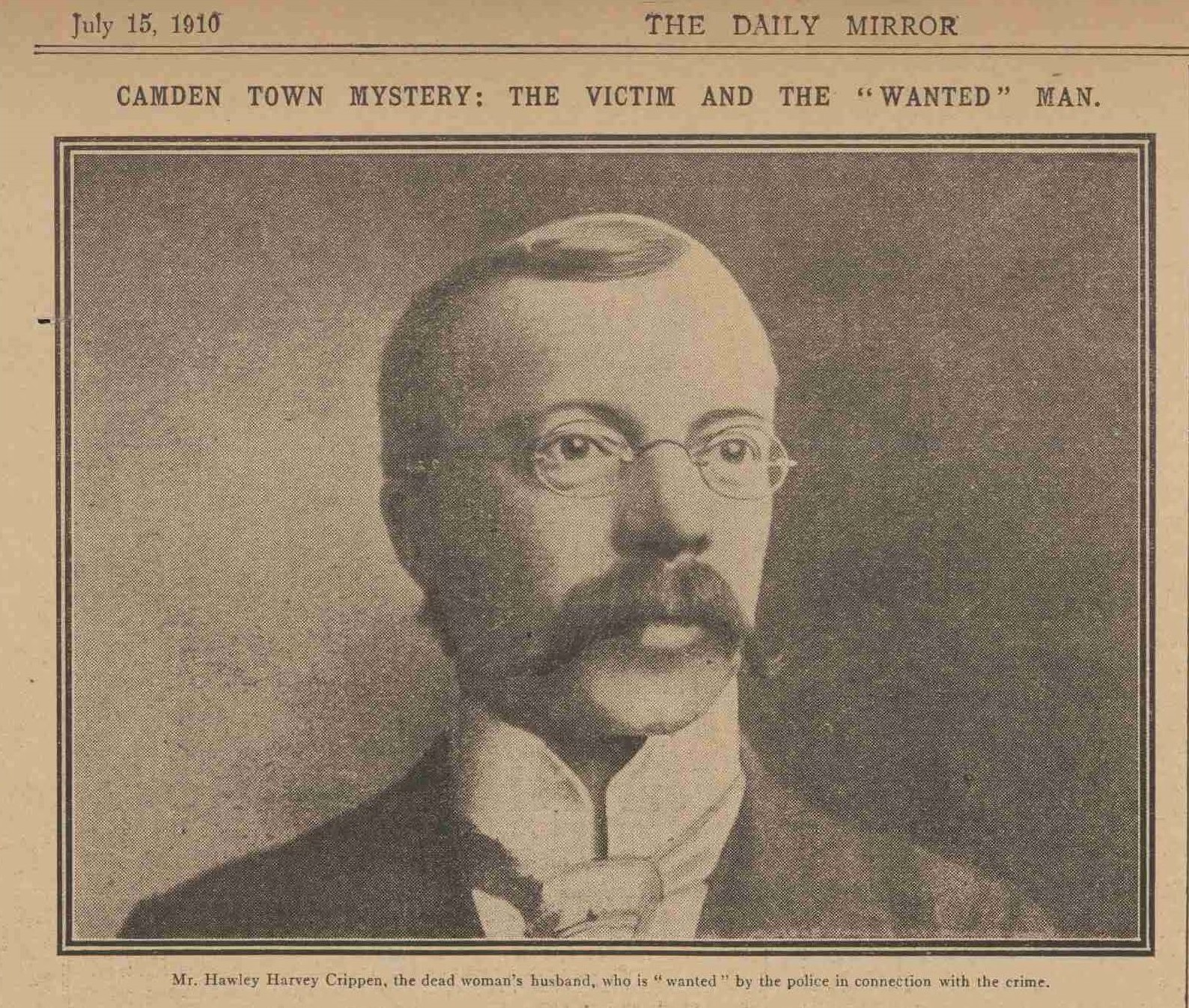 Hawley Harvey Crippen pictured in The Daily Mirror July 15, 1910.
It’s a crime drama that has been retold and scrutinized countless times over the past century, the story of Hawley Harvey Crippen, a slightly built, mild-mannered doctor accused of murdering and mutilating his wife, Cora Crippen. In the summer of 1910, a grisly discovery was made in the cellar of the Crippens’ London home at 39 Hilldrop Crescent: a mound of flesh, stripped of head, limbs, and bones. The shocking find, followed by Crippen’s desperate flight across the Atlantic with his mistress, Ethel Le Neve, and the sensational trial that ensued, ignited one of the most captivating media storms of the Edwardian age.
My fascination with the story came with my curiosity about Crippen’s unusual given name: Hawley. As someone who carries Hawley as a surname, seeing it used as a given name caught my attention. After all, it’s not every day you stumble on someone who shares your name in such a headline-making way. A few years ago, while researching my own Hawley family in Kalamazoo County, Michigan, just one county over from the Crippen family homestead in Branch County, I decided to visit a few Crippen-related sites in the area.
Before he set foot in London, Hawley Harvey Crippen was just a boy from a recently settled pioneer family in Coldwater, Branch County, Michigan, a region of quiet farmland and small trading towns that reflected the steady growth of the post–Civil War Midwest. He was born there in 1862 to Myron Augustus Crippen, a local merchant, and Andresse Skinner. His family’s roots in Branch County ran deep: his grandfather, Philo H. Crippen, and great-grandfather, Bradley Crippen, were among the area’s early settlers, buying land in the 1830s and firmly planting the Crippen name in Michigan soil.
Research revealed that Crippen may have received his first name “Hawley,” from his father’s family, handed down from his great-great-grandmother Currence Hawley, a descendant of Joseph Hawley, one of the early Hawley immigrants to America. Currence Hawley (Hard) and her daughter Esther, along with husband Bradley Crippen, appear in Elias Sill Hawley’s The Hawley Record, a large genealogical book that painstakingly tracks the early colonial Hawleys. The use of Hawley as a surname would continue with Crippen's son, Otto Hawley Crippen.
Not everyone admired the name, however. Crippen’s ill-fated wife, Cora, apparently refused to call him Hawley and instead nicknamed him “Peter.” Why she called him Peter is unknown, however, the rejection of his name was potentially one of those small but telling cracks in their marriage, a tension that preceded the darker tragedy to come. Of course, Belle was hardly in a position to criticize Hawley’s name, as she herself cycled through a small collection. Born Kunigunde Mackamotzki, she is listed as Corrine Turner on her marriage record, then reinvented herself as Belle Elmore on the stage, and was finally remembered by history as Cora Crippen.
The Crippen family lineage echoes the migration patterns of many early American families, including my own, moving gradually from the early settlements of Massachusetts and Connecticut into Vermont, New York, and eventually Michigan.
On his father Myron’s side, Hawley Crippen’s family traced its lineage to Thomas Crippen, born in England and recorded in Plymouth, Massachusetts, by 1665. Like many early settlers, Thomas built a life in the New World, but not without controversy. Period court records reveal that “on that date the court required a bond of £20 from John Robinson, plus £10 each from Robinson's two sureties, for his future good behavior, he having been convicted of some lascivious speeches and actions toward Frances, the wife of Thomas Crippin. Crippin was also accused of being a ‘pandor of his wife in lightnes and laciviousenes,’ and he, not being able to find sureties, was required to bind over to the court £40 in livestock and other property. Jonathan Hatch was convicted of unnecessarily frequenting the house of Thomas Crippin, giving rise to ‘suspision of dishonest behavior’ towards Crippin's wife, and he was warned to keep away from her or ‘hee will answare it att his peril.’”
After these early troubles, Thomas and his wife Frances relocated to Haddam, Connecticut, where he lived until his death around 1709. Their son, Jabez Crippen, born in Massachusetts, married Thankful Fuller, thus linking the family to her great-grandfather, Edward Fuller, a passenger on the Mayflower. This connection lent the Crippen line a measure of enduring colonial prestige, making Hawley Harvey Crippen a descendant of a Mayflower settler.
The Crippen family’s Revolutionary War legacy emerged through Jabez’s son John, and continued with John’s son Ezra. In the decades following America’s early conflicts, as the nation pressed westward, so too did the Crippen family. Ezra settled in Penfield, Monroe County, New York, where he worked as a farmer. His son Bradley, also born in New York, married Esther Hard and followed in his father’s agricultural footsteps. Through Esther’s mother, Currence Hawley Hard, the Hawley lineage entered the Crippen ancestry.
Crippen’s great-great-grandmother, Currence Hawley, was born in Connecticut and descended from the earliest Hawley emigrant, patriarch Joseph Hawley. In 1764, her father Josiah Hawley migrated to Arlington in Bennington County, Vermont, accompanied by his brothers Jehiel and Abel, and their father Ephraim. There, Jehiel built the town’s first frame house and soon owned one of the region’s largest farms. He also founded the local Episcopal church, where many Hawley gravestones remain today. For a time, the Hawleys ranked among Arlington’s leading families, until the Revolutionary War revealed that some members were Loyalists. Several, including Jehiel, ultimately departed for Canada, joining other Loyalists seeking refuge there.
From New York, the Crippens’ pioneering spirit carried forward through Bradley and Esther, who left the state for the developing frontier of Coldwater in Branch County, Michigan, around 1835. Their westward trek led them through dense forests, winding rivers, swampy stretches, and the broad expanse of the Great Lakes. Once settled in Coldwater, Bradley’s son Philo joined his brother Lorenzo Dow Crippen in the local economy, establishing themselves through milling, merchandising, and real estate ventures.
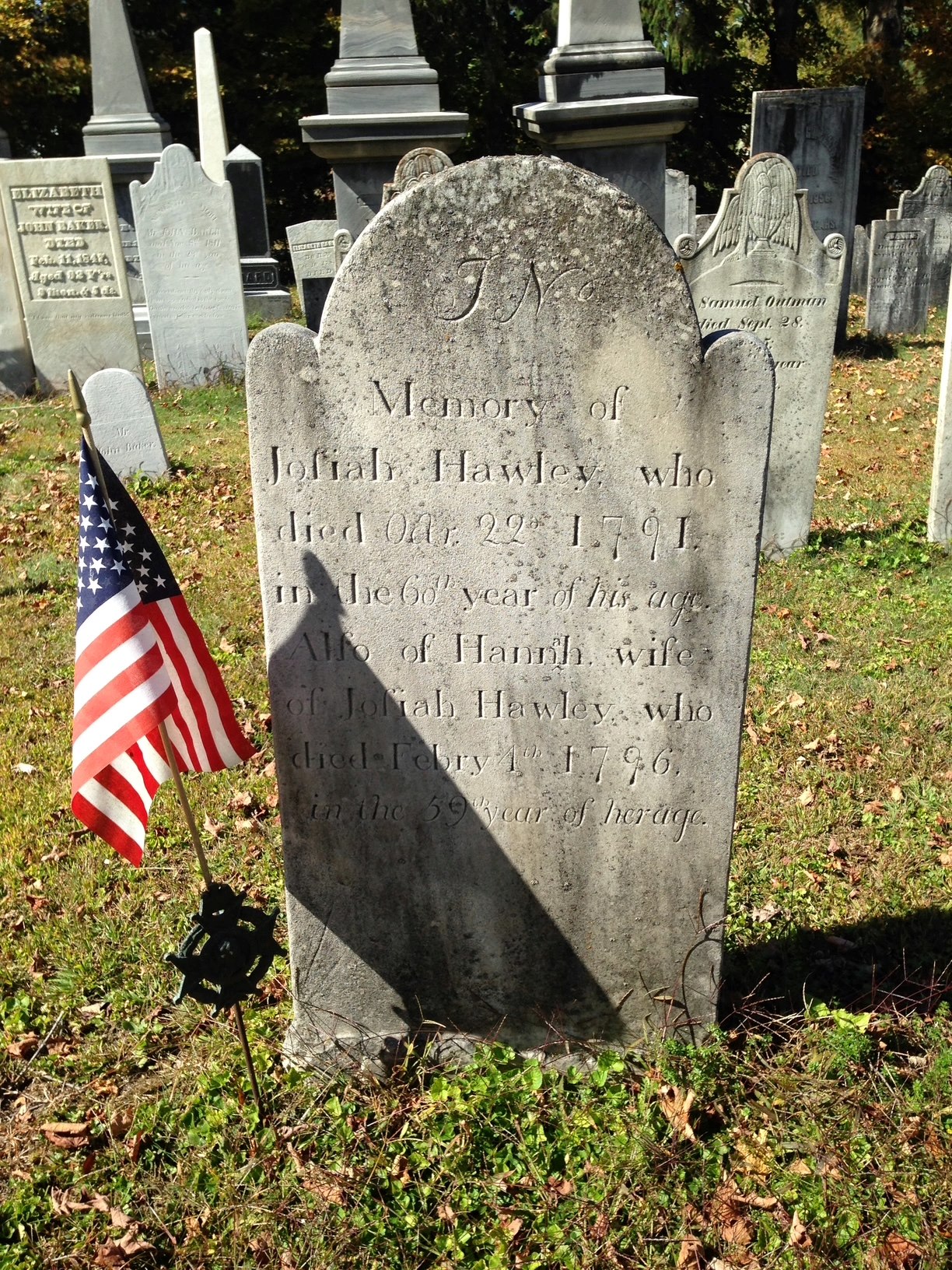 In 2013, I took this photo of the gravesite of Josiah Hawley, Crippen's 3rd great grandfather, in Arlington, Vermont.
P Marlin
In 2013, I took this photo of the gravesite of Josiah Hawley, Crippen's 3rd great grandfather, in Arlington, Vermont.
P Marlin
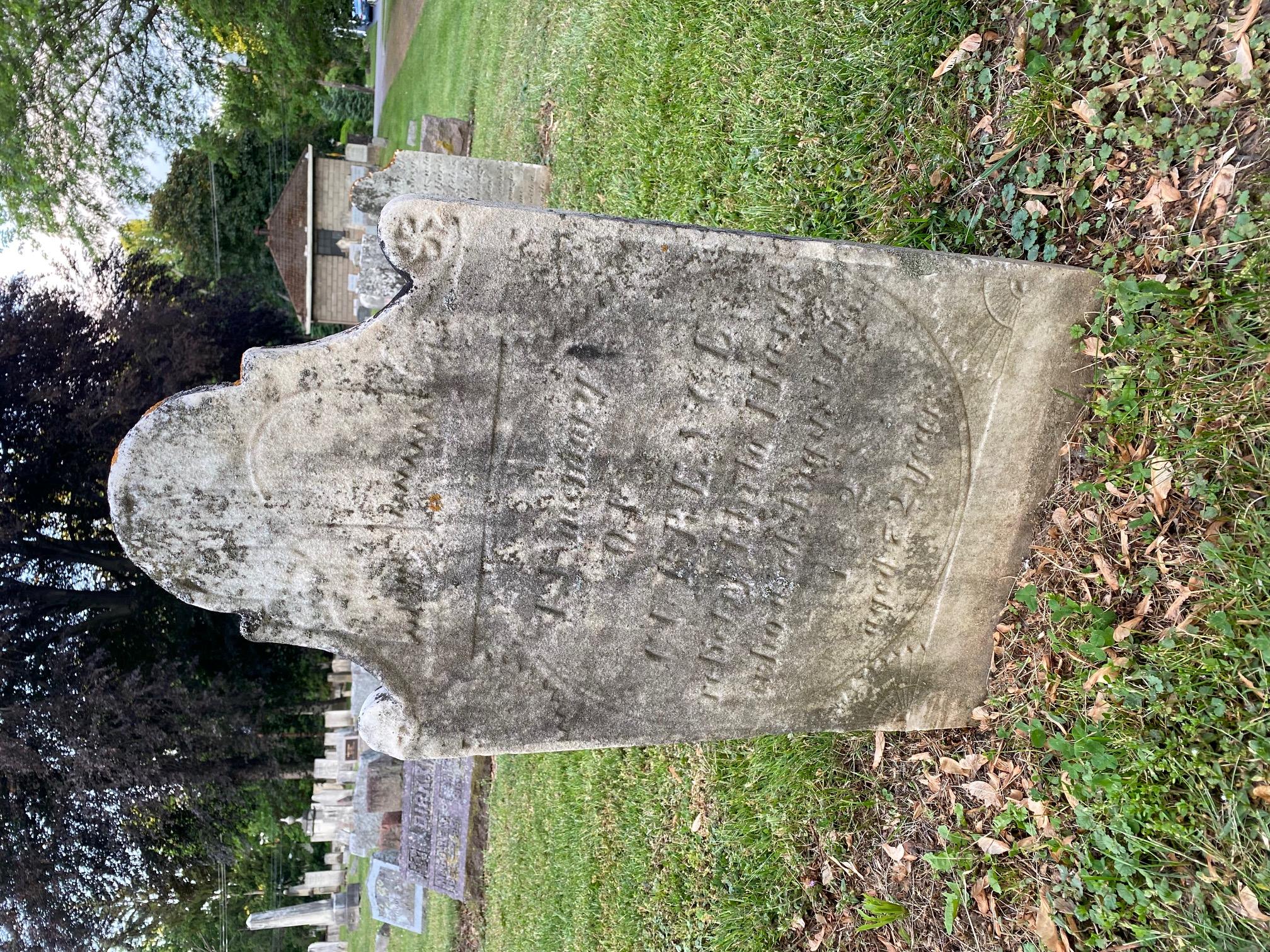 A photo of the gravesite of Crippen’s great-great-grandmother,
Currence Hawley Hard in Penfield, New York. P Marlin 2021
A photo of the gravesite of Crippen’s great-great-grandmother,
Currence Hawley Hard in Penfield, New York. P Marlin 2021
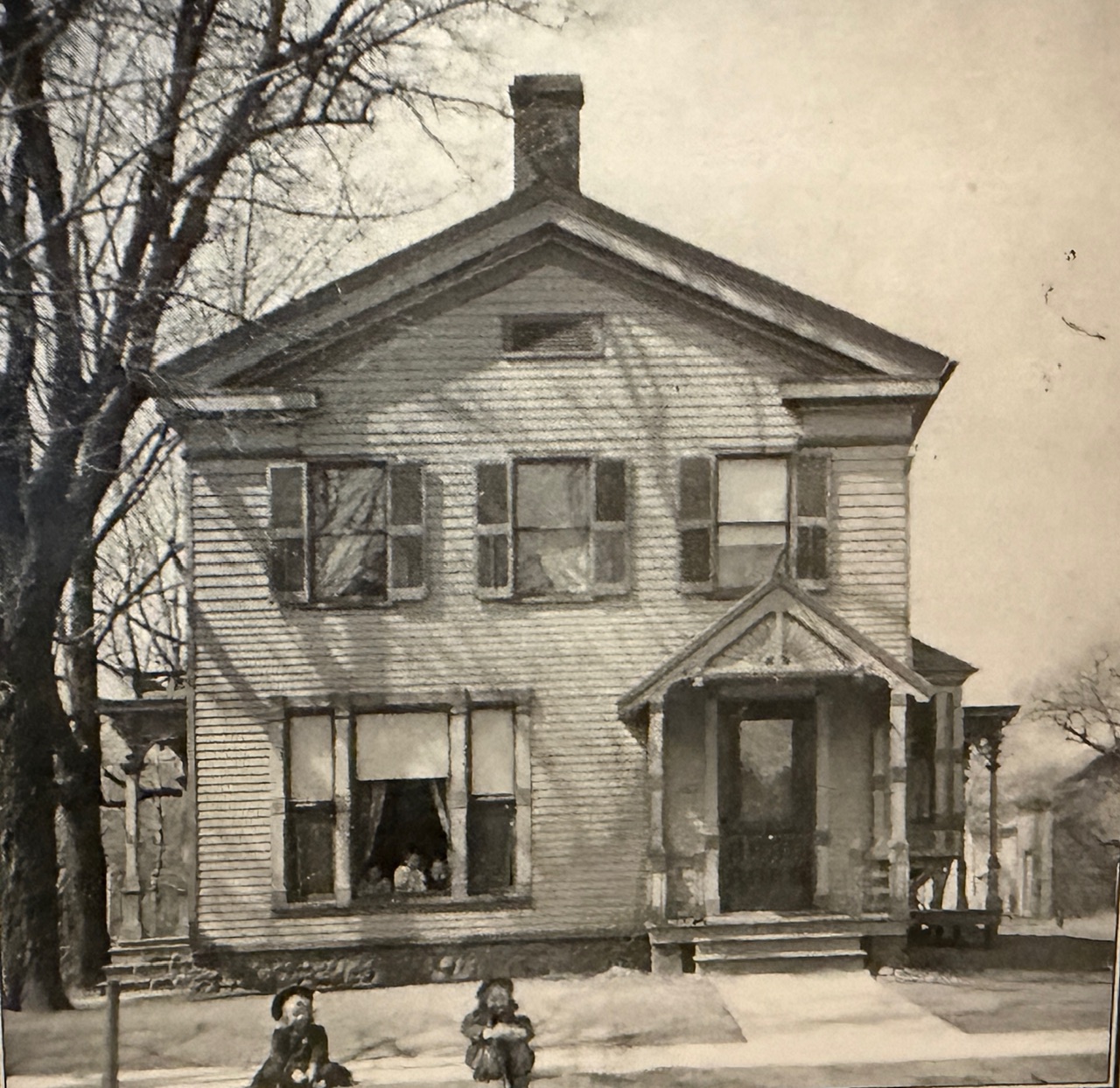 The Coldwater, Michigan house built by Philo Crippen (Hawley Crippen's grandfather).
In 1906, the house was renovated to include the addition of columns as seen in the next photo.
Branch County Historical Society
The Coldwater, Michigan house built by Philo Crippen (Hawley Crippen's grandfather).
In 1906, the house was renovated to include the addition of columns as seen in the next photo.
Branch County Historical Society
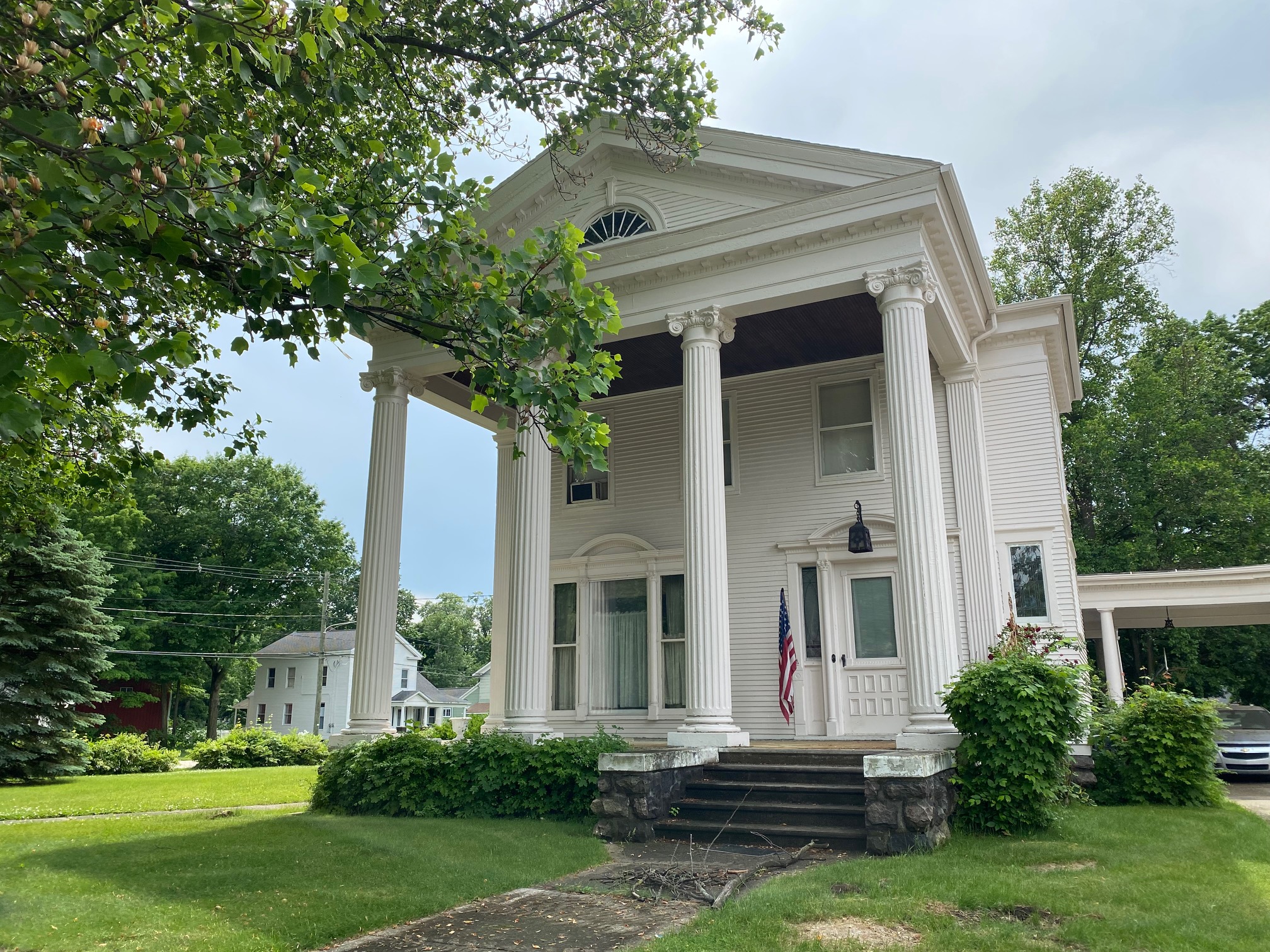 The Philo Crippen (Hawley Crippen's grandfather) House in Coldwater, Michigan as it looks
today. P Marlin 2021
The Philo Crippen (Hawley Crippen's grandfather) House in Coldwater, Michigan as it looks
today. P Marlin 2021
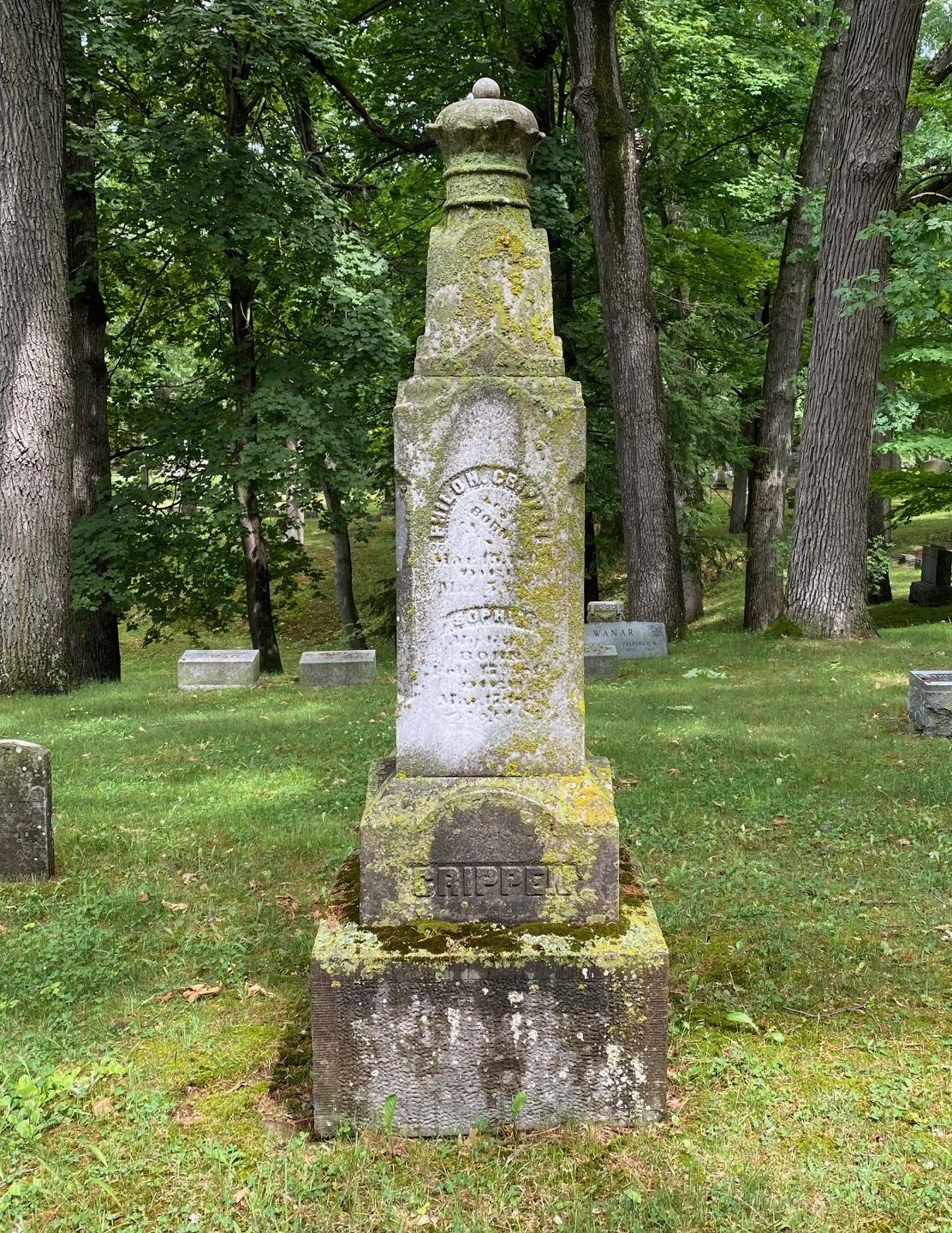 Philo Crippen, Hawley Crippen's grandfather, gravesite in Coldwater, Michigan. P Marlin 2021
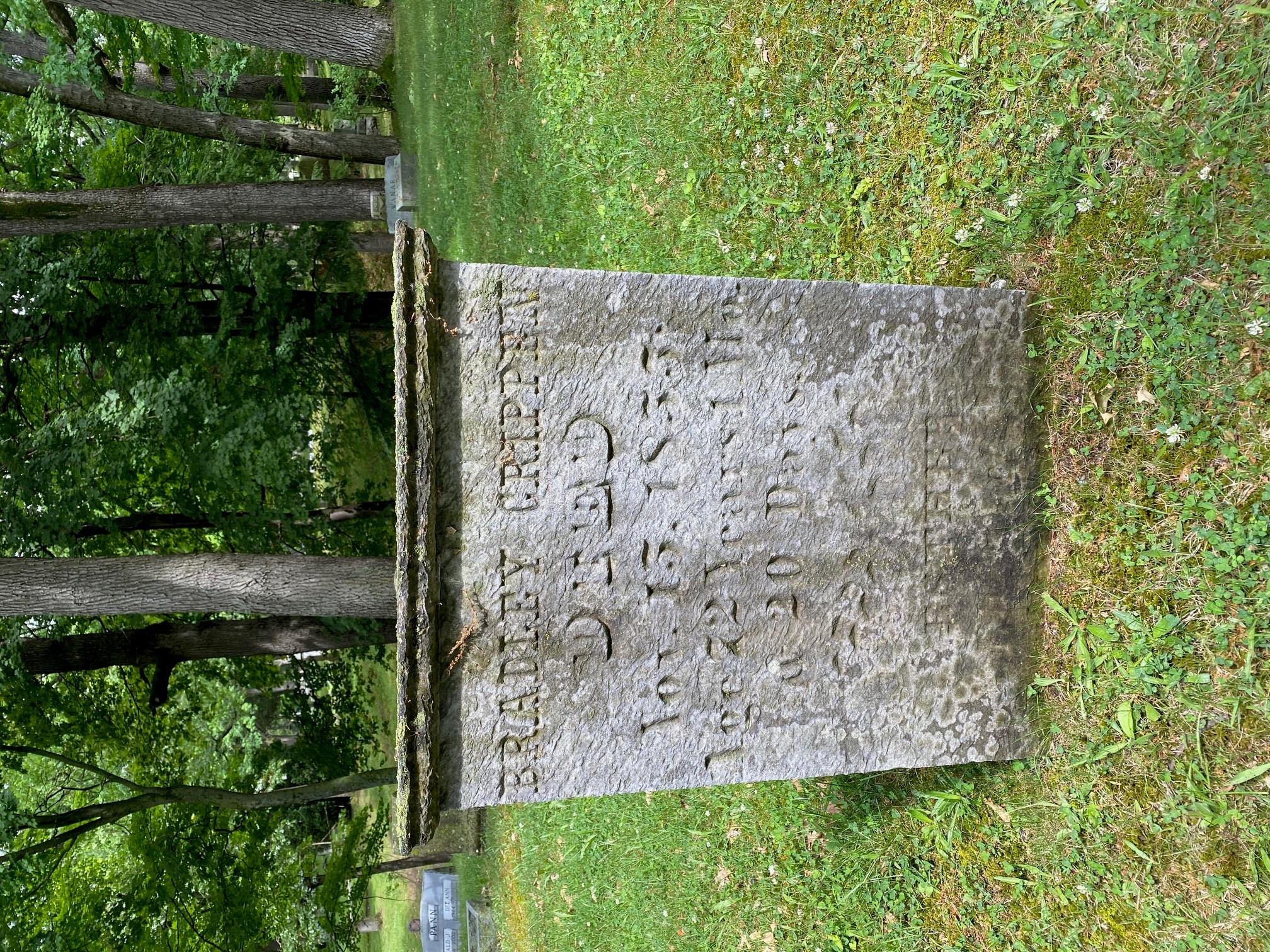 Bradley Crippen, Hawley Crippen's great-grandfather, gravesite in Coldwater, Michigan. P Marlin 2021
From his modest rural upbringing, Hawley Crippen, perhaps following in the footsteps of his cousin Bradley Crippen, a practicing physician in Coldwater, chose to pursue a career in medicine. Drawn to the emerging field of homeopathy, he went on to earn a degree in homeopathic medicine from the Cleveland Homeopathic Medical College. From there, Hawley Crippen went on to pursue a series of medical ventures. In America, homeopathy was fashionable enough to attract patients, but it also sat uneasily on the margins of “serious” medicine. His practice took him from New York to California, moving wherever opportunity, or necessity, took him. Each stop was a fresh attempt to reinvent himself, whether in private practice or through work with one of the booming patent medicine companies that promised cures for every ailment under the sun.
Crippen first traveled to London in 1883. He visited several hospitals to see operations, even spending time at the Royal Bethlehem Hospital, better known as “Bedlam,” the centuries-old institution infamous for its treatment of the mentally ill. It was during this period that he first reported using the poison hyoscine in treating patients with mental illness. It was the same substance that was found in Cora Crippen's remains.
Between 1886 and 1896, Crippen’s career was largely spent back in the United States, where he practiced medicine and searched for professional stability. It was also during this period that he married his second wife (the first one died), the would-be opera singer Corrine “Cora” Turner and began working for Munyon’s Homeopathic Home Remedy Company.
 Hawley Harvey Crippen and Cora Turner Crippen pictured in The Daily Mirror on August 2, 1910.
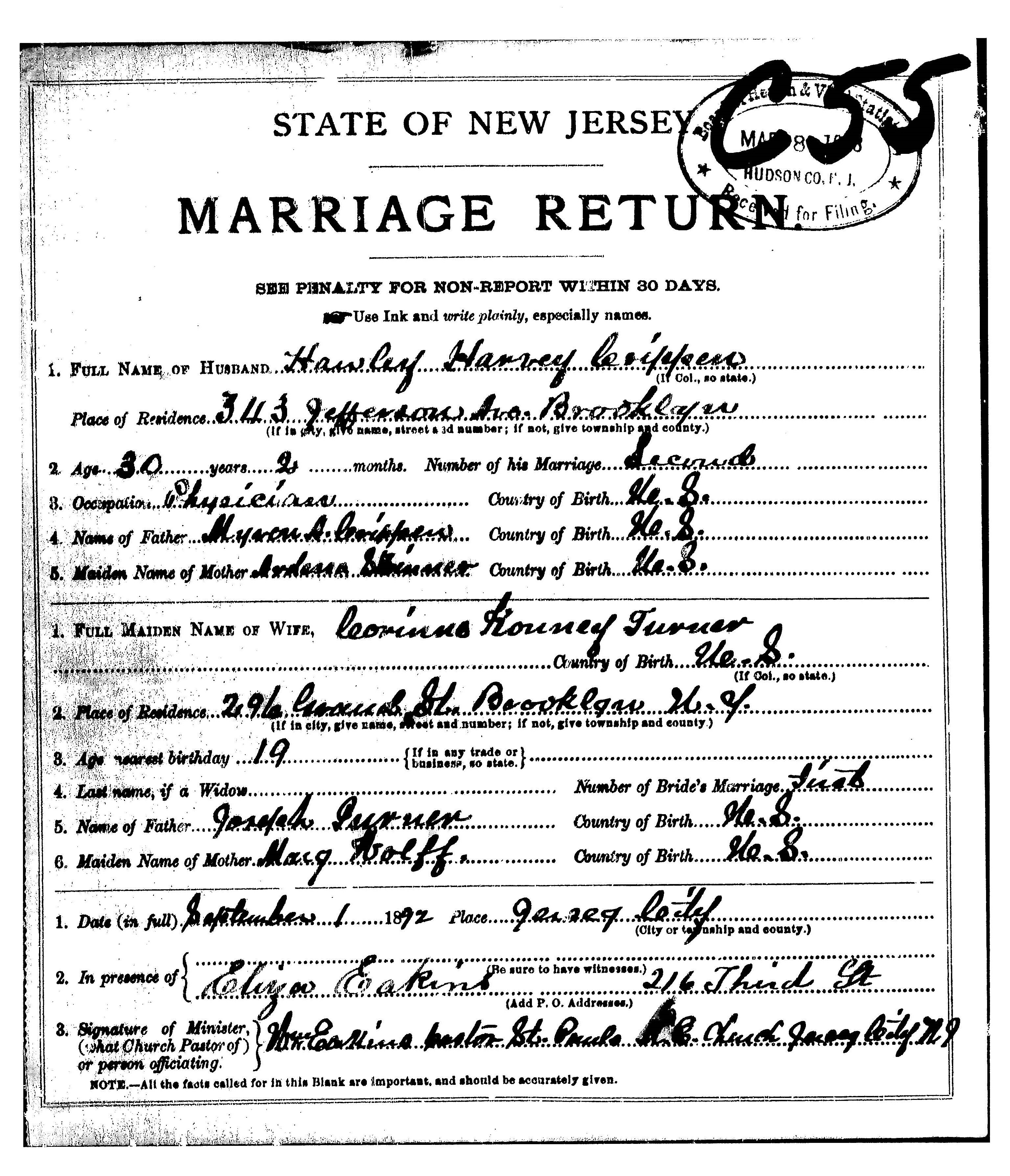 Hawley Harvey Crippen and Corinne Turner New Jersey marriage record.
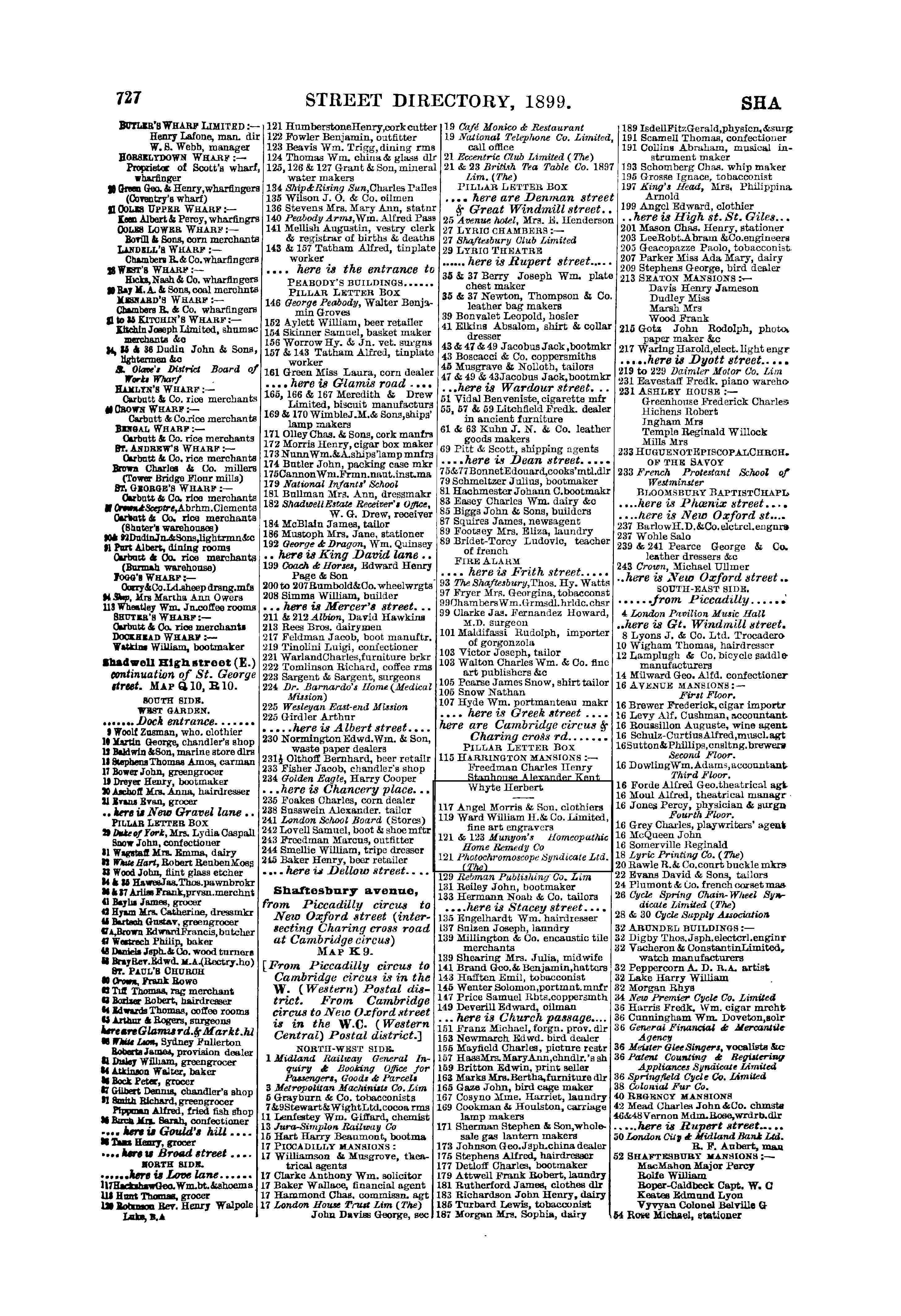
Crippen’s employment with Munyon’s Homeopathic Home Remedy Company began in New York City, where he served as a consulting physician for the patent-medicine giant, an enterprise known for its endless array of cure-alls and bold health claims. Around 1899, after settling in London with Belle, Crippen continued his association with Munyon’s by managing their offices at 121 Shaftesbury Avenue.
The 1899 London directory lists Munyon's Homeopathic Home Remedy Company at 121 Shaftesbury, situated just two doors down from Morris Angel & Son Clothiers at 117 Shaftesbury Avenue. Morris Angel & Son, a costume supplier established near London’s vibrant theater district, later expanded to include 119 Shaftesbury Avenue, where it operated for many years. In the historic photograph below, the number “121” is visible on the doorway next to Angel’s at 119. Today, the portion of the building once occupied by Angel’s still stands, while the section that housed 121 Shaftesbury Avenue has been replaced by a modern brick structure.
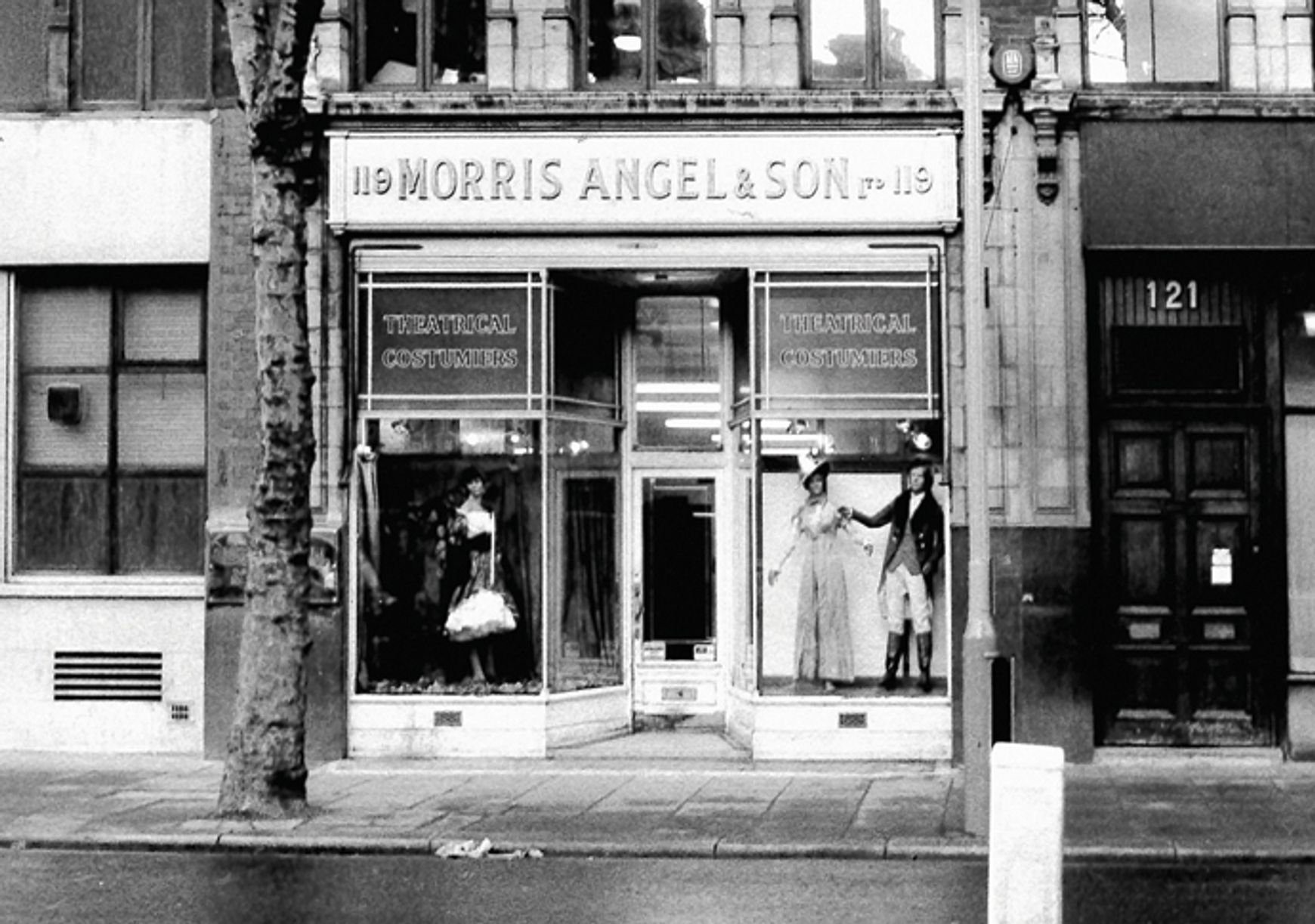 A historic photo of 119-121 Shaftesbury Avenue in London. Munyon's was
located at 121 Shaftesbury in 1899. Tom Cullen, author of "Crippen: The Mild Murderer,"
indicates that some of Belle's clothing had been taken Angel's on Shaftesbury,
however, I could not find record of it.
Layers of London
A historic photo of 119-121 Shaftesbury Avenue in London. Munyon's was
located at 121 Shaftesbury in 1899. Tom Cullen, author of "Crippen: The Mild Murderer,"
indicates that some of Belle's clothing had been taken Angel's on Shaftesbury,
however, I could not find record of it.
Layers of London
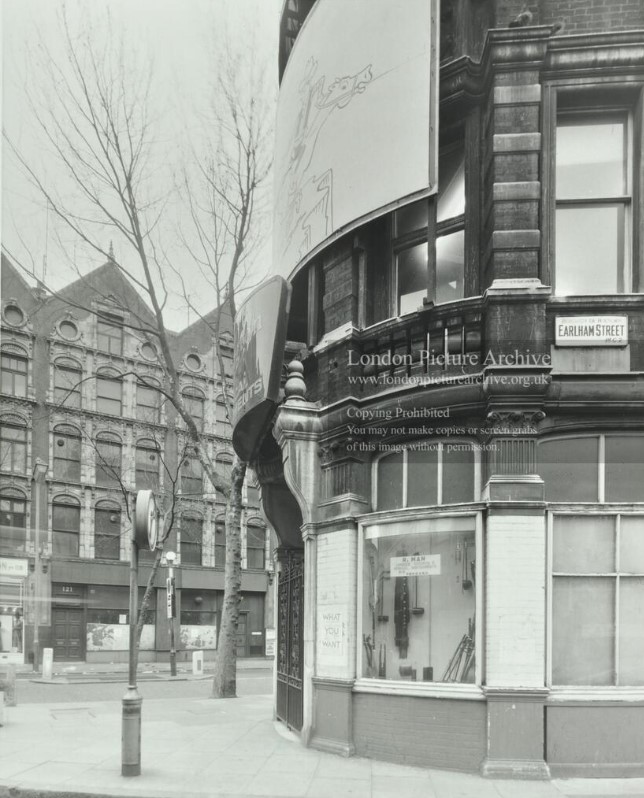 Another historic view of 119-121 Shaftesbury Avenue in London which reveals more of
121 Shaftesbury building (across the street) which has since been replaced
by the modern brick building.
London Picture Archive
Another historic view of 119-121 Shaftesbury Avenue in London which reveals more of
121 Shaftesbury building (across the street) which has since been replaced
by the modern brick building.
London Picture Archive
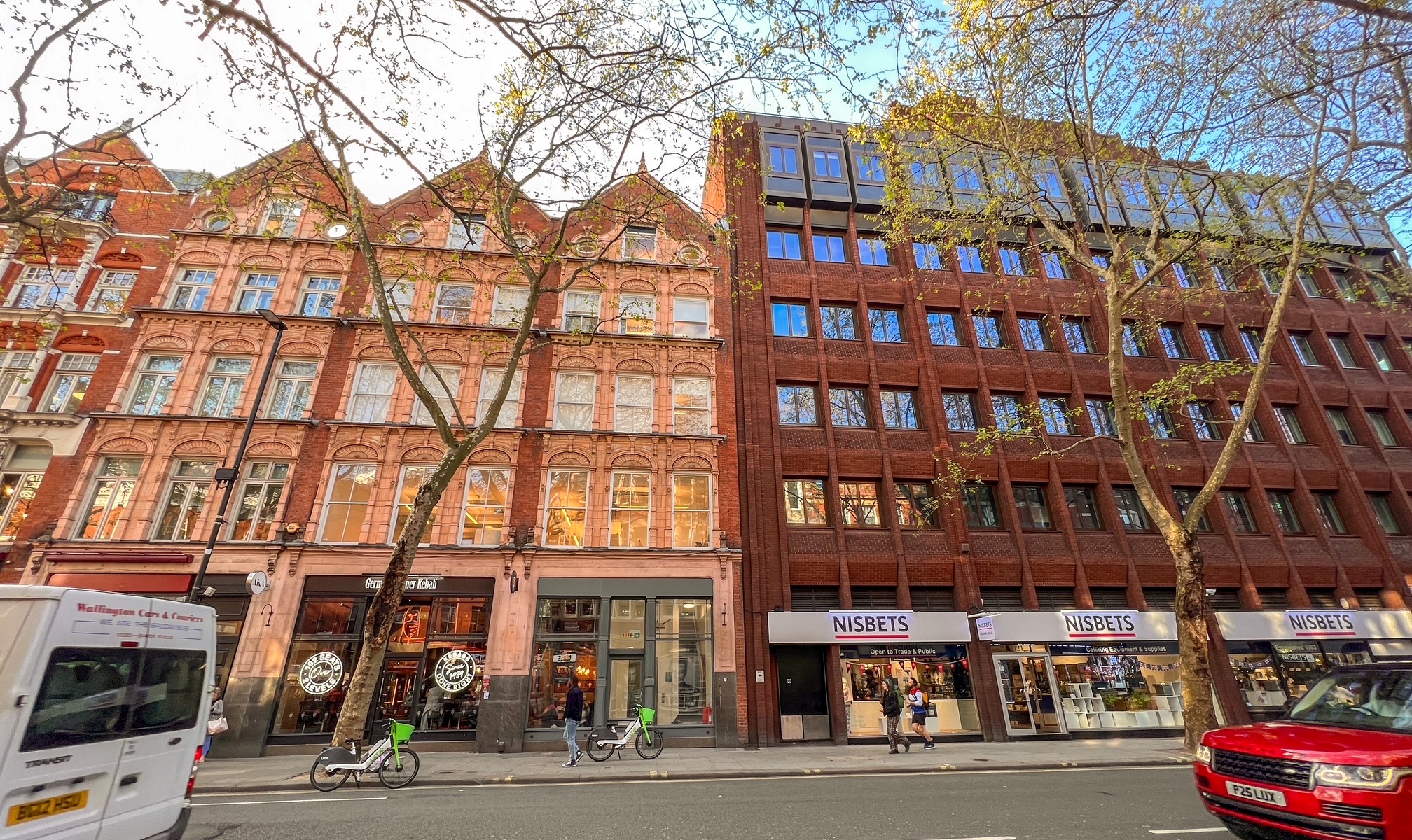 A modern day view of 119-121 Shaftesbury Avenue. The building
that housed 119 Shaftesbury Ave (Angel's) is still standing, however, 121 Shaftesbury
has been replaced by a modern brick building (Nisbets).
P Marlin 2023
A modern day view of 119-121 Shaftesbury Avenue. The building
that housed 119 Shaftesbury Ave (Angel's) is still standing, however, 121 Shaftesbury
has been replaced by a modern brick building (Nisbets).
P Marlin 2023
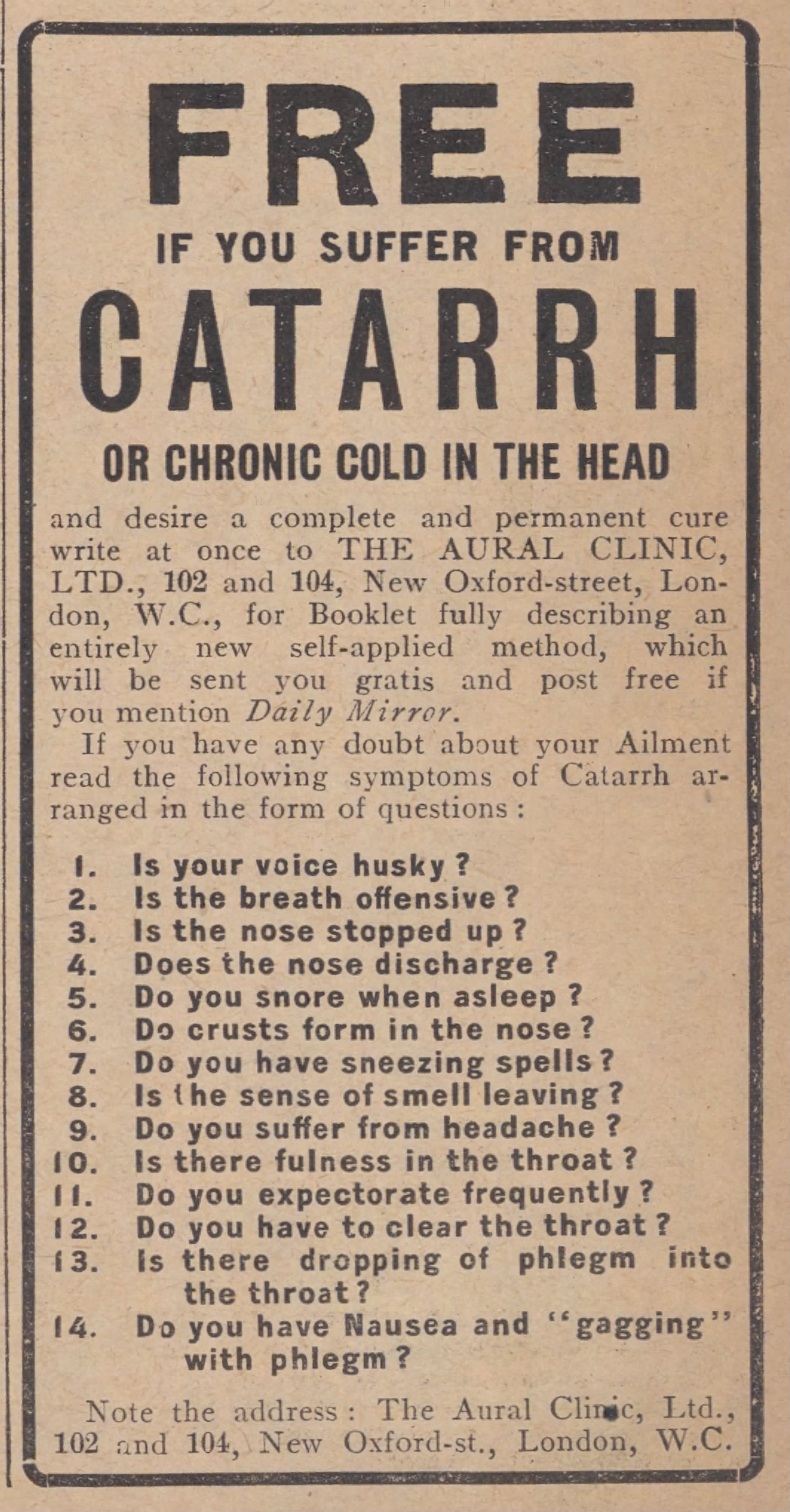
Over the next few years Crippen ventured into a handful of shaky businesses, the Drouet Institute (10 Marble Arch) where he met his future mistress, Ethel le Neve, the Sovereign Remedy Company (13 Newman Street), and the Aural Clinic Company (102 New Oxford Street), all of which failed. Soon, however, Crippen rejoined Munyon’s at their new offices at Regent House, inside the Peter Robinson building at Oxford Circus.
 Munyon's Homeopathic Home Remedy Company posts notice of address
change from Shaftesbury Avenue to Regent Street in The Chemist and Druggist
(1889). In one of his final letters to Ethel before his death, Crippen indicated that
Munyon had offered a $12,000.00 reward for anyone who could find Belle.
Munyon's Homeopathic Home Remedy Company posts notice of address
change from Shaftesbury Avenue to Regent Street in The Chemist and Druggist
(1889). In one of his final letters to Ethel before his death, Crippen indicated that
Munyon had offered a $12,000.00 reward for anyone who could find Belle.
 Munyon’s offices at Regent House within the Peter Robinson building at Oxford Circus,
where Crippen served as both manager and advertising manager.
Munyon’s offices at Regent House within the Peter Robinson building at Oxford Circus,
where Crippen served as both manager and advertising manager.
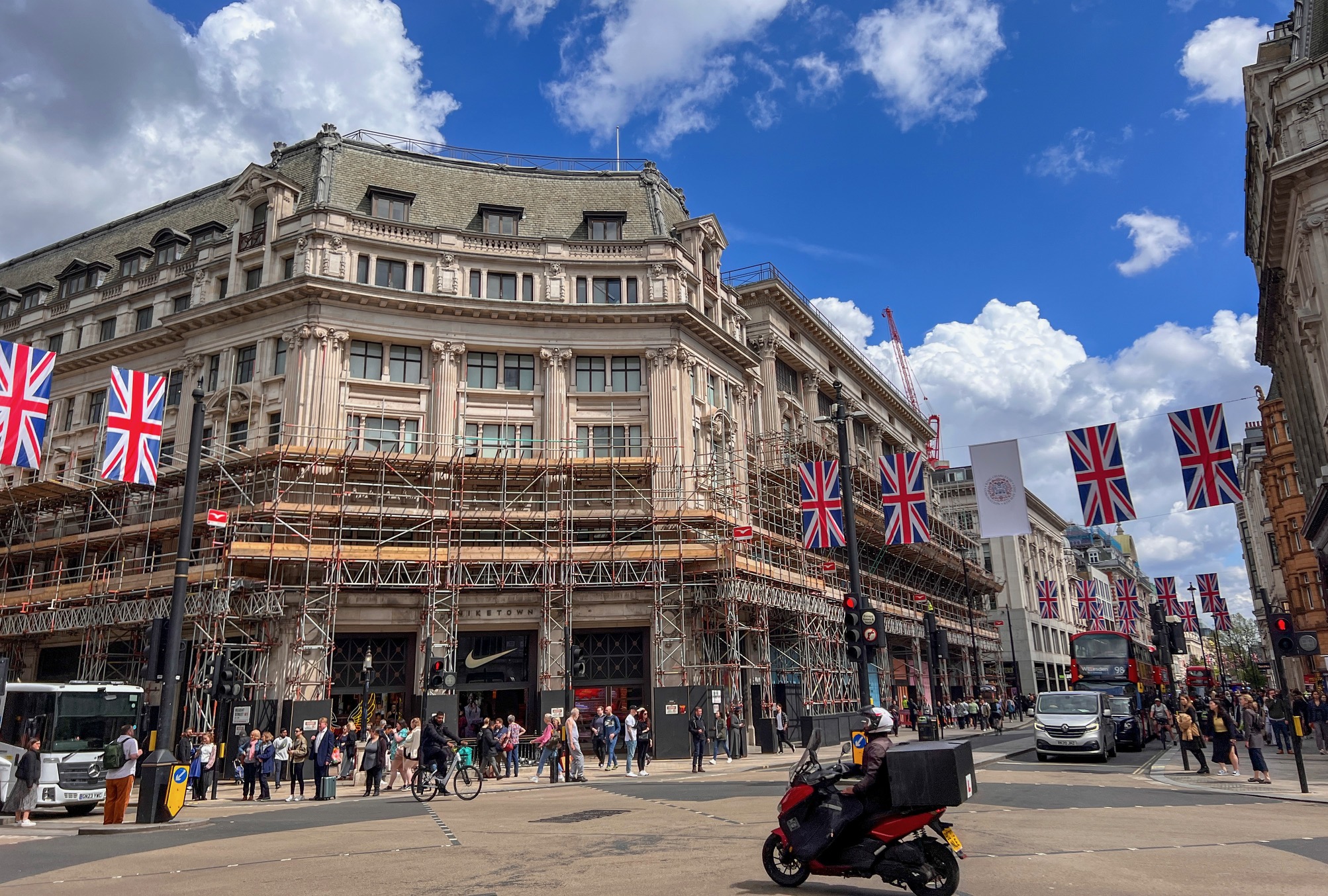 The same building as above photographed during King Charles III
Coronation event in 2023. P Marlin
The same building as above photographed during King Charles III
Coronation event in 2023. P Marlin
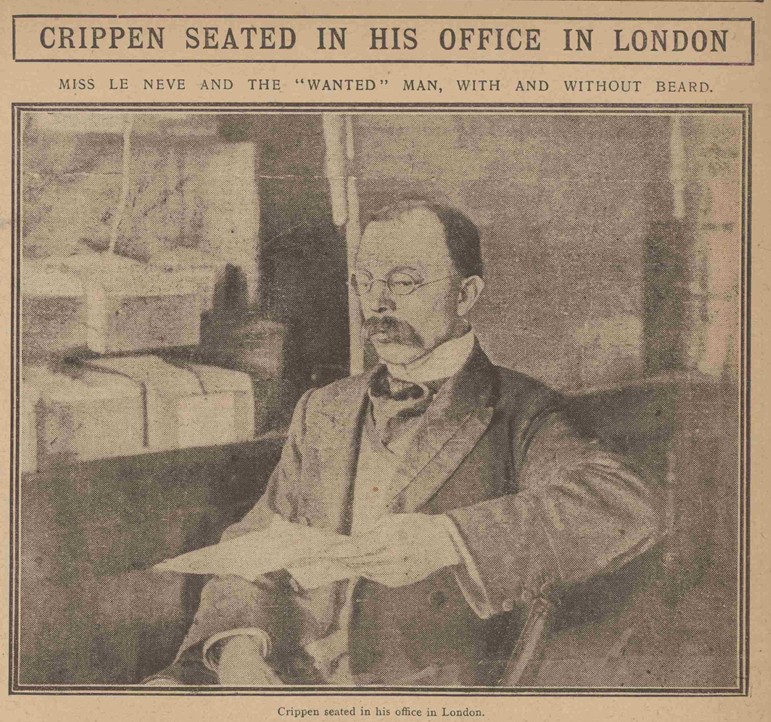 Crippen pictured in his London office in The Daily Mirror on July 18, 1910.
It's not clear in which London office this photo was taken.
Crippen pictured in his London office in The Daily Mirror on July 18, 1910.
It's not clear in which London office this photo was taken.
In London, Crippen's wife, Cora, pursued her musical ambitions on stage. As part of her stage activities, she worked with the Music Hall Ladies’ Guild, a charitable society created to support performers in need. This included support for the wives and families of performers, offering food, clothing, and other charitable assistance when illness, misfortune, or financial hardship struck. Under the stage name, Belle Elmore, she held a position as honorary treasurer of the Guild and threw herself into the group’s fundraising dinners and social events.
In September 1909, Belle attended the Music Hall Ladies’ Guild’s second annual dinner held at the Boulogne Restaurant on Gerrard Street. That evening she was honored with a “handsome jewel,” a basket of pink roses, and an inscribed silver-framed address that read: “To Miss Belle Elmore in recognition of her services to the Music Hall Ladies’ Guild from the ladies of the executive committee at our second annual dinner.” Visibly moved, Belle replied, “I do not know how to thank you all for this lovely present. I really do not think I deserve it. I never expected anything like this. The work I have done for the Guild I did because I loved it; my reward was that we were always pretty successful.” (The full speech is reprinted in the article below.) Within just a few months of this warm tribute, Belle would be dead.
At that time, Gerrard Street was still largely residential, a quiet contrast to today’s bustling Chinatown. Yet at No. 27 stood the Hotel de Boulogne, established in 1874 by Philippe Ganosse. Remarkably, the hotel’s original mosaic survives at the entrance. Visitors today can still walk across the very same tiles that Belle and her fellow Guild members crossed on that autumn evening, an ordinary detail now made poignant by the tragedy soon to unfold.
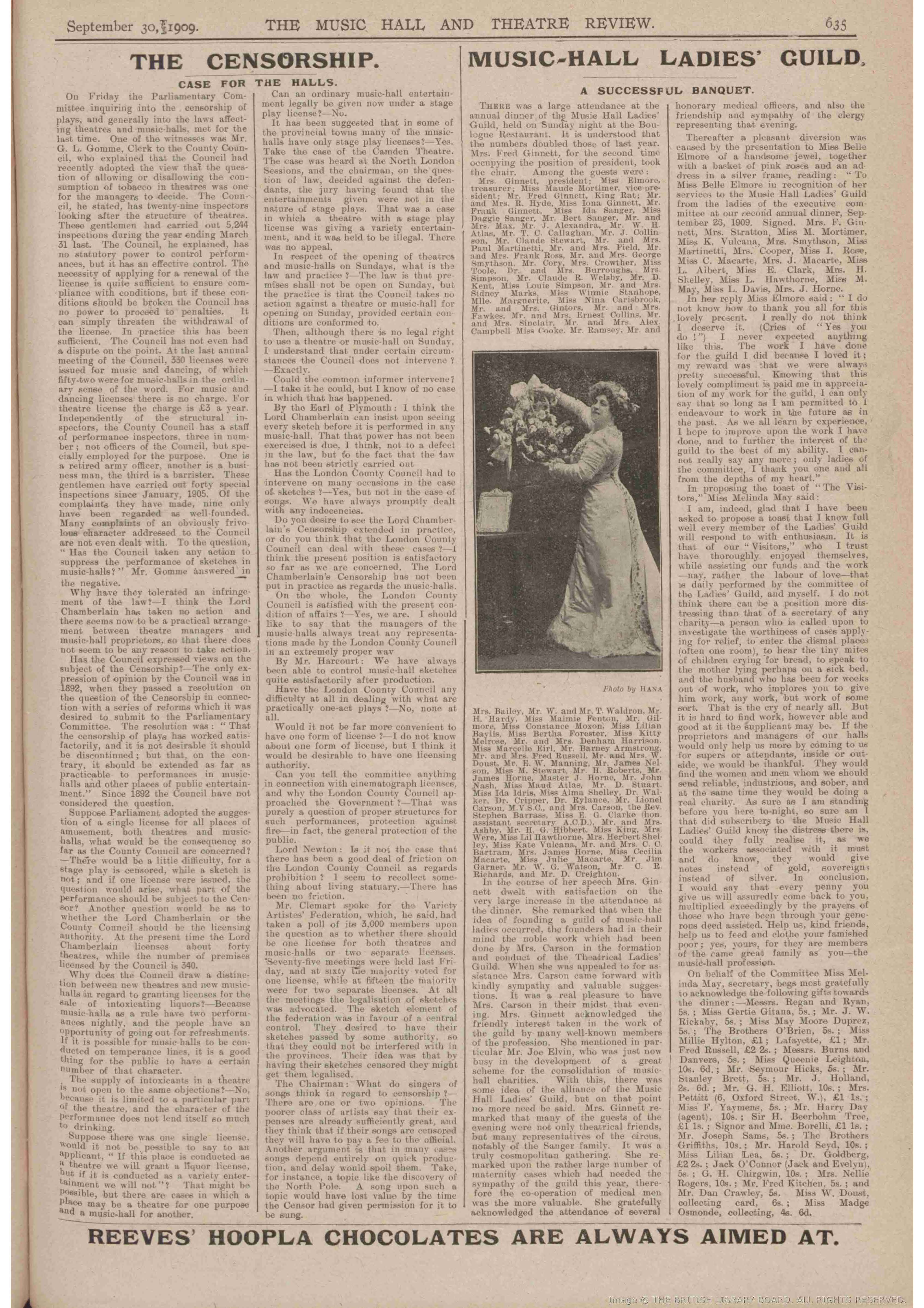 The Music-Hall Ladies' Guild "A Successful Banquet" from The Music Hall and
Theatre Review publication dated September 30, 1909. The article includes a
a photograph of Cora. Full article
The Music-Hall Ladies' Guild "A Successful Banquet" from The Music Hall and
Theatre Review publication dated September 30, 1909. The article includes a
a photograph of Cora. Full article
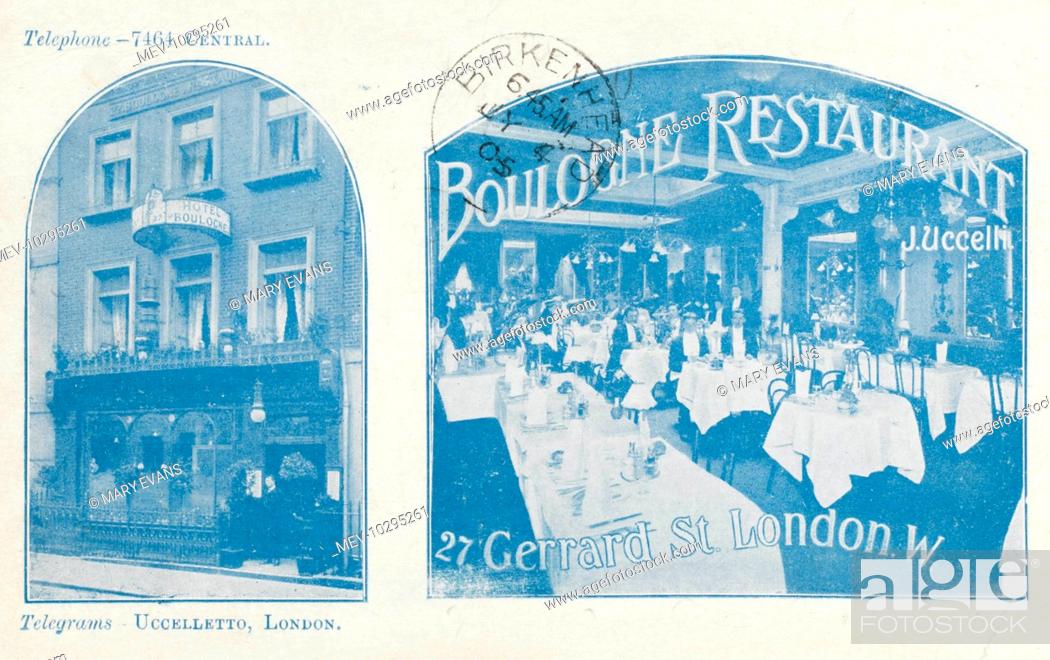 This vintage postcard provides a view of the original Hotel de Boulogne hotel and restaurant.
A remaining distinguishing feature includes the rounded architectural feature above (right) the door.
This vintage postcard provides a view of the original Hotel de Boulogne hotel and restaurant.
A remaining distinguishing feature includes the rounded architectural feature above (right) the door.
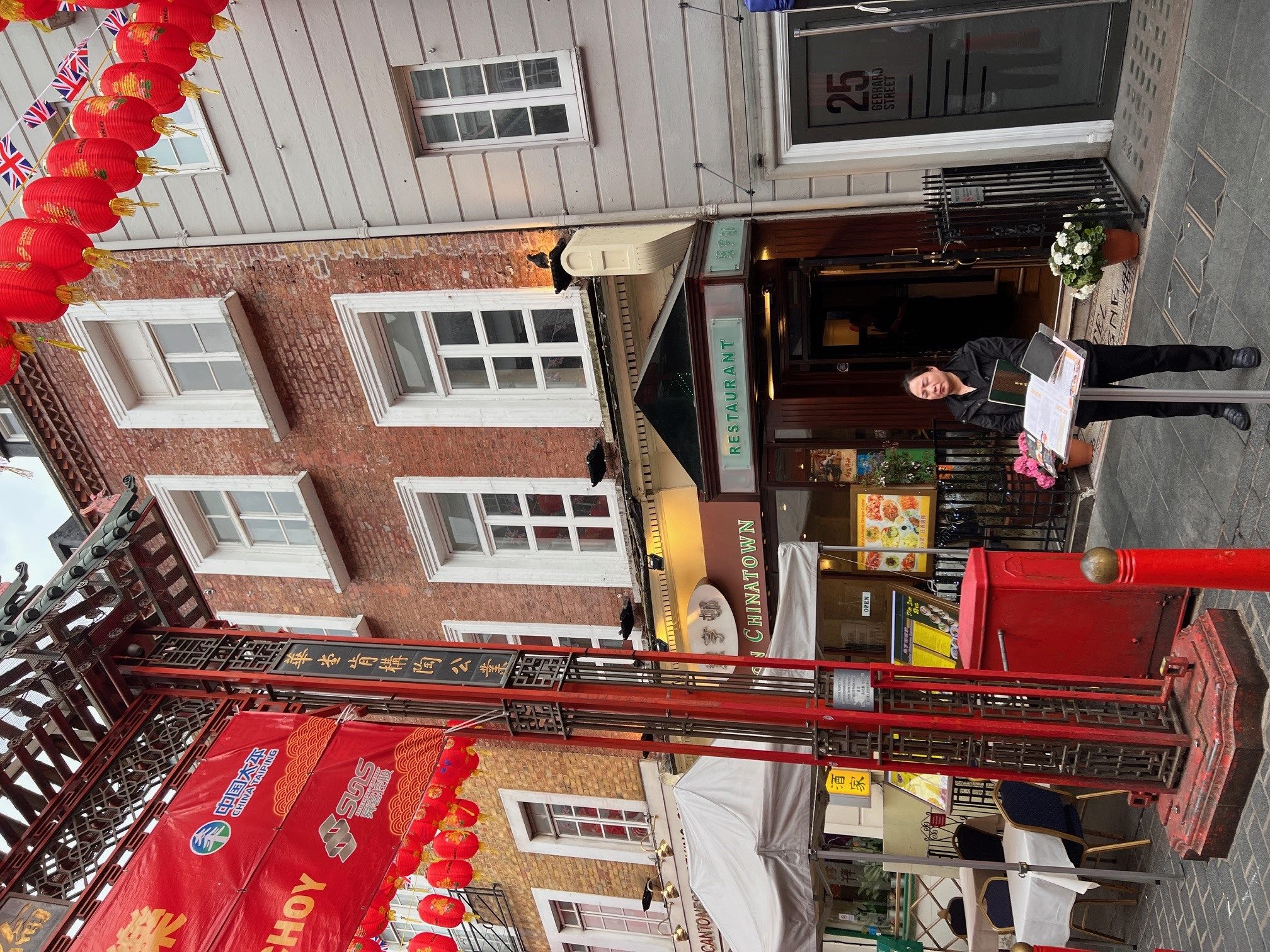 The former Hotel de Boulogne at 27 Gerrard Street is a Chinatown restaurant today. P Marlin 2023
 A view of the entrance and former Hotel de Boulogne mosiac at 27 Gerrard Street.
Closer view of mosaic P Marlin 2023
A view of the entrance and former Hotel de Boulogne mosiac at 27 Gerrard Street.
Closer view of mosaic P Marlin 2023
By February 1910, the Ladies’ Guild found itself drawn into the mystery of Belle’s sudden disappearance. Members grew uneasy when she stopped appearing at meetings, and their suspicions deepened after receiving strangely worded letters from Crippen attempting to explain her absence. The unease turned to outright alarm when, instead of Belle, Crippen arrived at the Music Hall Artists’ Railway Association Benevolent Fund event at the Criterion restaurant at Piccadilly Circus on February 20, accompanied by his secretary (and mistress), Ethel le Neve.
The Criterion glittered that night with its famous gold mosaic ceiling, hosting the “who’s who” of the music-hall profession. Yet the warmth and opulence of the room could not soften the cold stares Ethel must have endured as she appeared so openly at Crippen’s side. Among those in attendance were Mr. and Mrs. Paul Martinetti, close friends of the Crippens, who had secured tickets for the event; they may well have noticed Ethel wearing one of Belle’s own jewels, a striking “rising sun” brooch.
Built in 1874, the Criterion’s opulent interior with the golden mosaic ceiling remains today, though when I visited in 2023, the former restaurant was under renovation. One of the workers kindly took a photograph of the interior for me, a modern glimpse into the same glittering halls where, on that February evening in 1910, Crippen brazenly displayed his lover, and Ethel at last stepped into the life of respectability and glamour she had long desired.
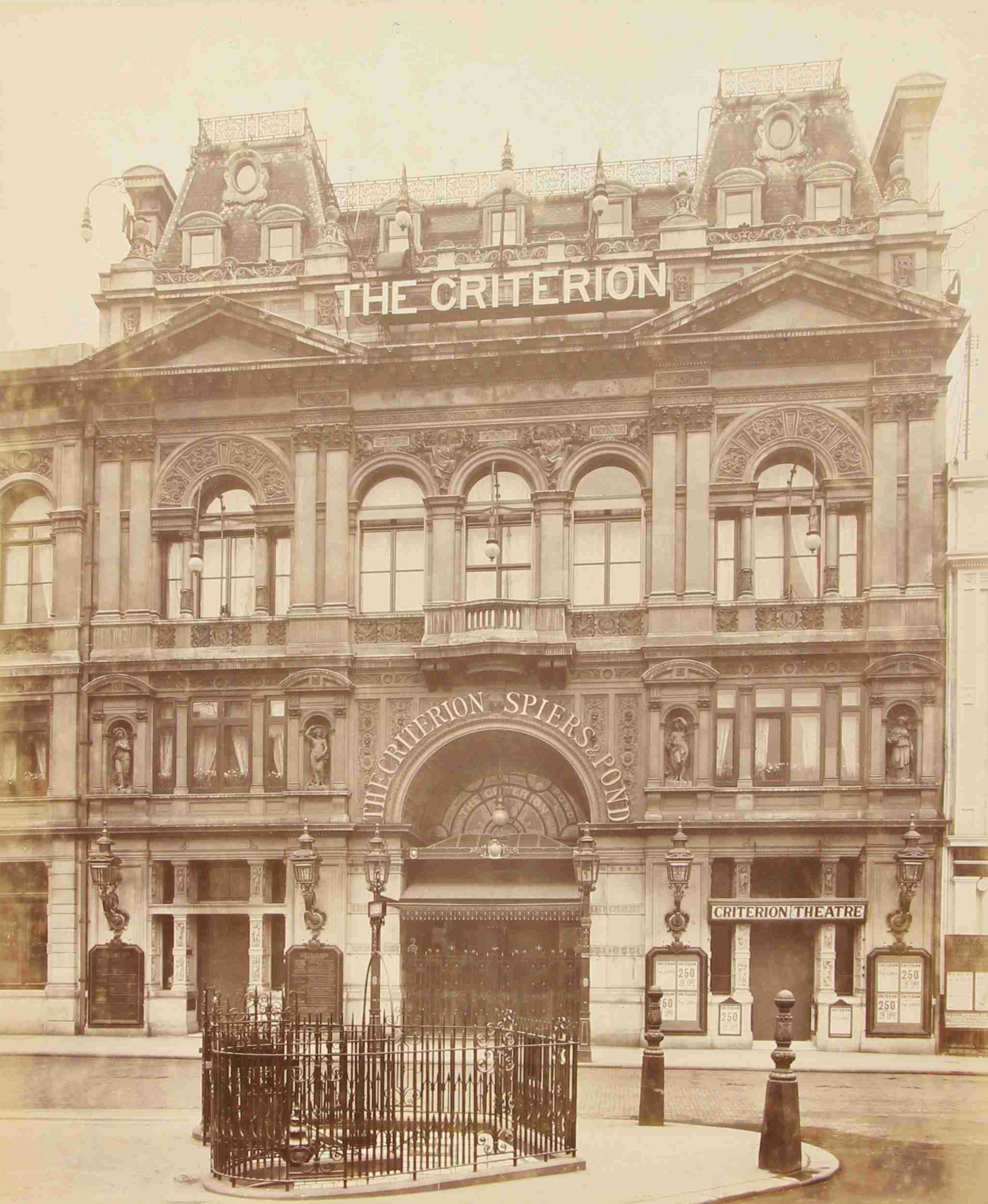 The Criterion building (photo 1898). UK National Archives Images (licensed)
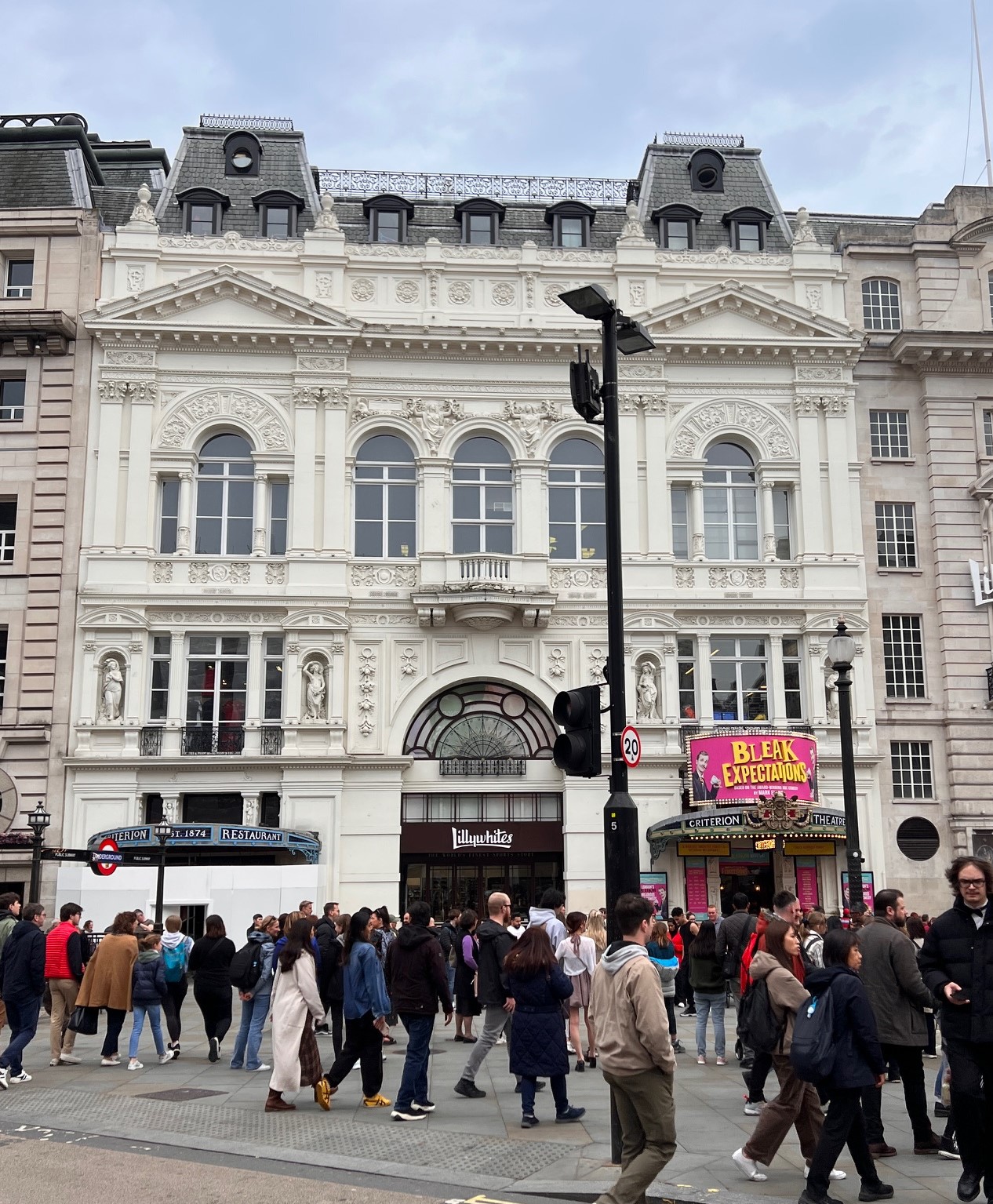 The Criterion building in 2023. The original restaurant, located on the left side, is boarded up. P Marlin
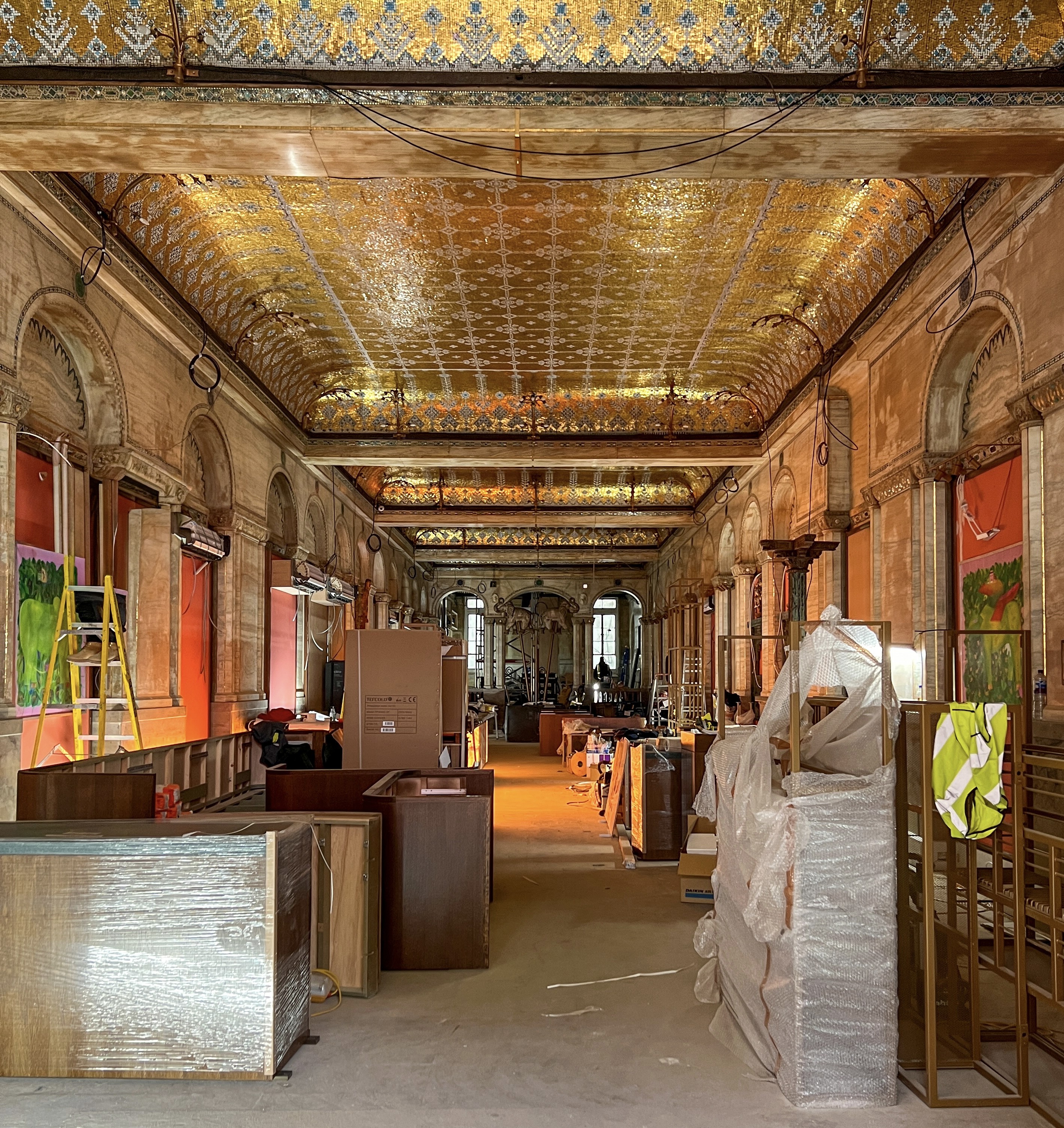 A view inside the historic restaurant being renovated in 2023. P Marlin
By 1908, Crippen was employed at the Albion House on New Oxford Street. A product of Victorian ambition, New Oxford Street was carved out in the 1840s to sweep away the infamous squalor of St. Giles rookery. By Crippen's time, the street had settled into a brisk, workaday rhythm. An afternoon stroll would take one past a variety of names and trades including Smith James & Sons, umbrella makers at No. 57 (a business that survives to this day); Albion House at Nos. 59-61; Pears, the soap refiners, at Nos. 71–75; Harper’s Electric Piano Company and Paul Mourabas, translator of languages, at No. 83; Faludi Sigmond, a dealer in postage stamps at No. 85; and Nash & Hill, letter cutters, at No. 87. Also located on New Oxford Street at No. 102 was the Aural Clinic where Crippen was once employed, and then at No. 108 stood Lewis & Burrows, chemists, where he had obtained the hyoscine that would later secure his place in infamy.
Constructed after the old Bedford Chapel was demolished in 1896, the forthcoming Albion House site had been acquired by the Lighting Corporation (Limited). Interestingly, before construction began on the new building, the corporation staged a public demonstration of a new fire extinguisher. An event no doubt drawing a curious crowd to the very pavement where, years later, the Crippen drama would play out.
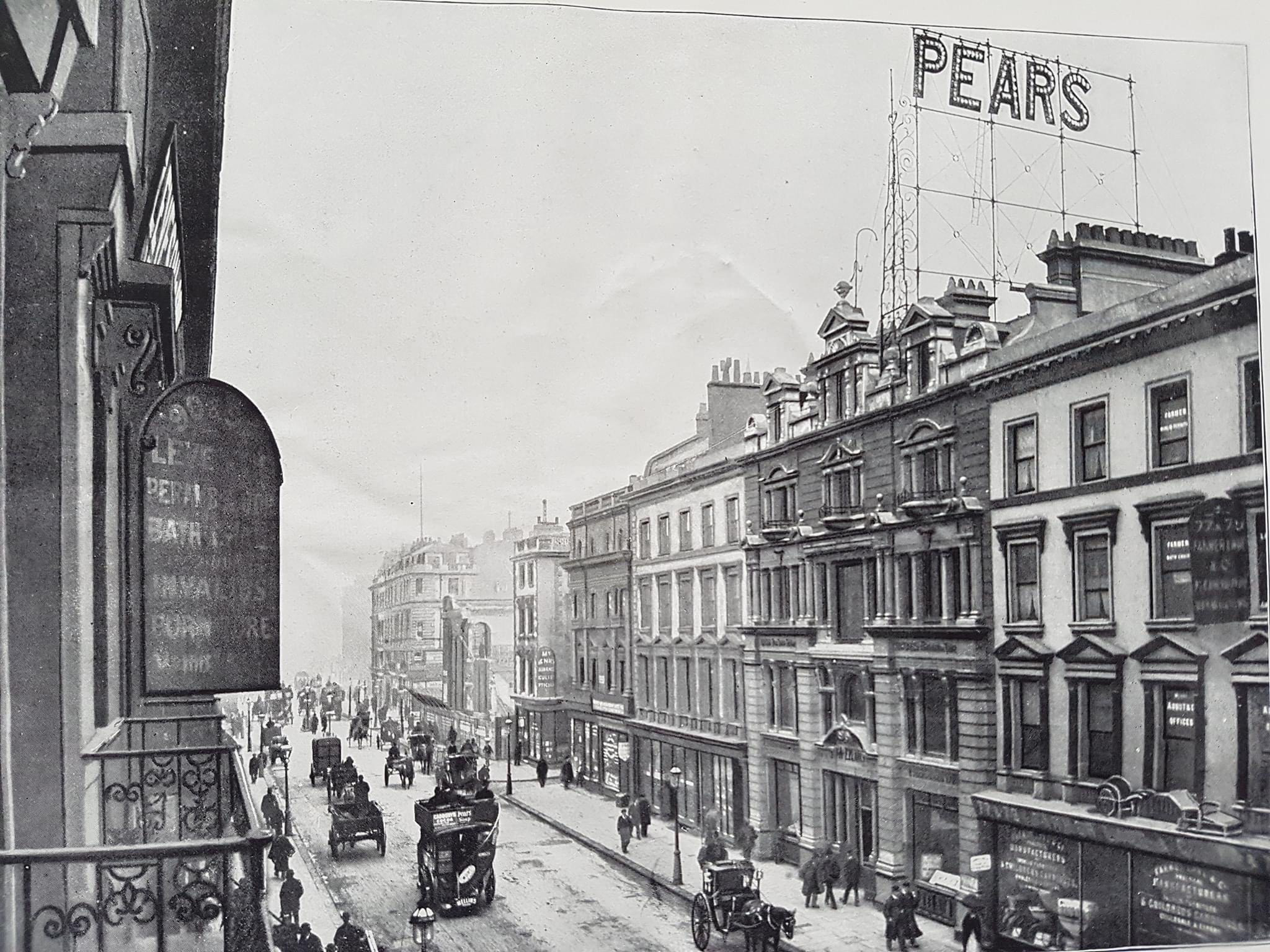 A view of Crippen's New Oxford Street, between 108 New Oxford Street and 59 (formerly 57) New Oxford Street (James Smith Umbrellas).
In the distance, the remains of the Bedford Chapel, which was being torn down (future site of Albion House), is visible.
Also note the Pears soap building which is still standing today. Round London (George Newnes, 1896).
A view of Crippen's New Oxford Street, between 108 New Oxford Street and 59 (formerly 57) New Oxford Street (James Smith Umbrellas).
In the distance, the remains of the Bedford Chapel, which was being torn down (future site of Albion House), is visible.
Also note the Pears soap building which is still standing today. Round London (George Newnes, 1896).
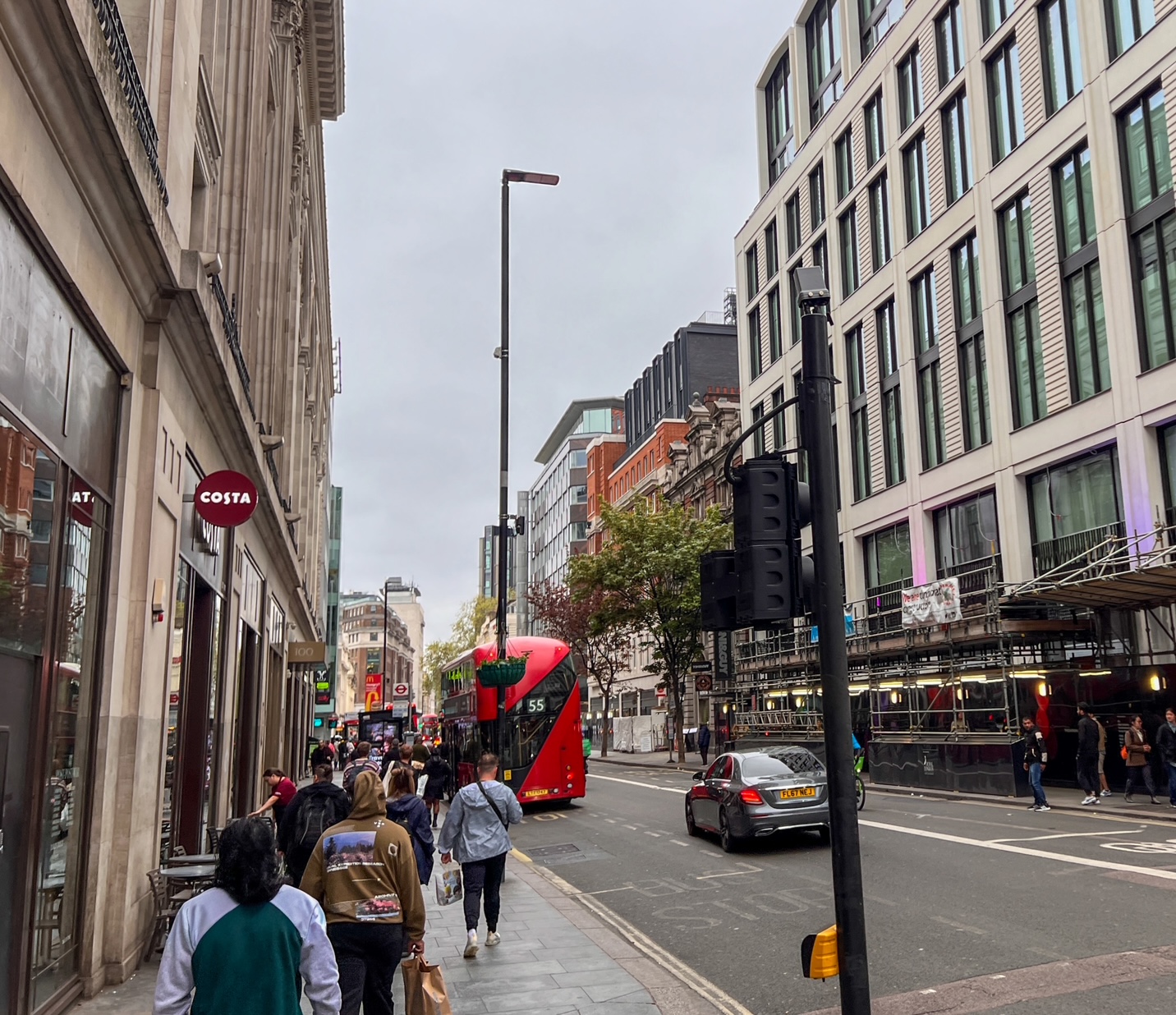 A ground level view of New Oxford Street near the same location as the photo above.
The Pears building is barely visible behind a tree amongst modern skyscrapers.
A photo of the former Pears building today.
A ground level view of New Oxford Street near the same location as the photo above.
The Pears building is barely visible behind a tree amongst modern skyscrapers.
A photo of the former Pears building today.
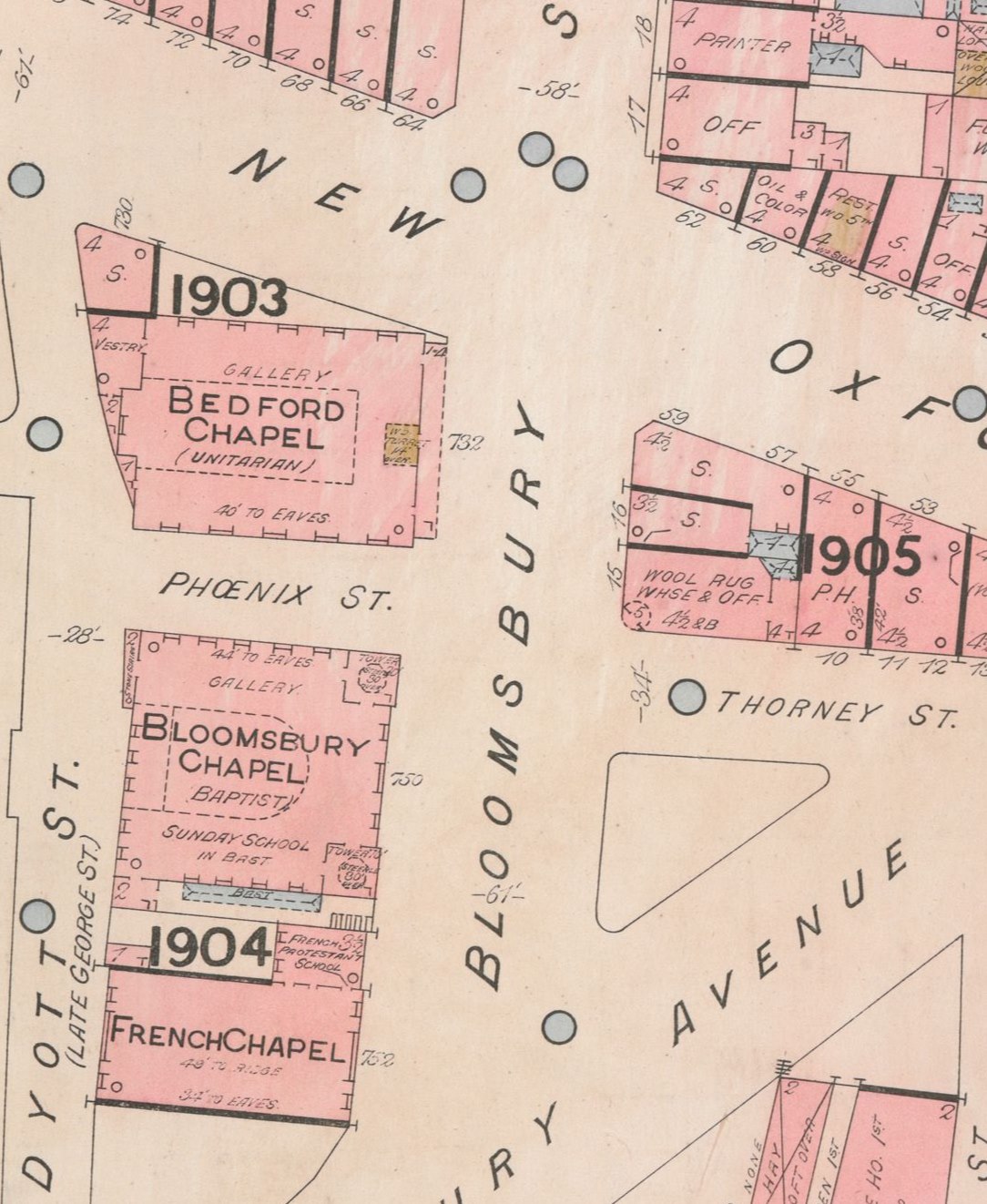 A map showing Bedford Chapel, the future site of Albion House. Bloomsbury
Street was renamed Shaftesbury Avenue by 1940.
A map showing Bedford Chapel, the future site of Albion House. Bloomsbury
Street was renamed Shaftesbury Avenue by 1940.
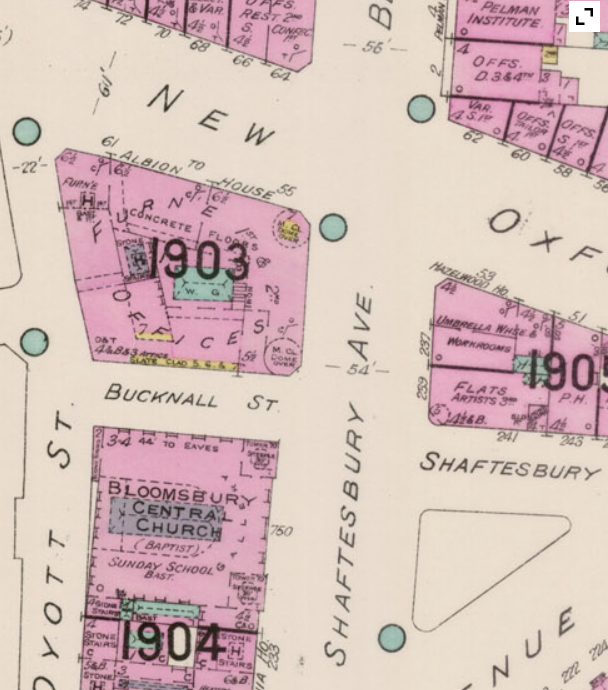 A map showing Albion House located on the former site of the Bedford Chapel.
Notice the drawings of the Albion House domes.
Goad Street maps 1940
A map showing Albion House located on the former site of the Bedford Chapel.
Notice the drawings of the Albion House domes.
Goad Street maps 1940
In the years leading up to 1910, familiar faces began to gather at the newly constructed Albion House, turning the modern business block into an unlikely stage for the unfolding Crippen drama. Among its tenants was Munyon’s Homeopathic Home Remedy Company, Crippen's longtime employer. By November 1909, however, Crippen's time with Munyon's was coming to an end. He had decided to partner with Dr. Gilbert Rylance, a dental surgeon also located in Albion House. The 1910 London directory listed the business as Crippen & Rylance, artificial teeth manufacturers, though the business was eventually renamed Yale Tooth Specialists.
Ethel Le Neve’s employment often followed Crippen’s, and she soon joined him at Albion House. The arrangement preserved much of the freedom she and Crippen had grown used to when they worked together, though now it came with greater risk. The Music Hall Ladies’ Guild, where Cora served as treasurer, also held weekly Wednesday meetings in Albion House. Under one roof, husband, wife, and mistress now crossed paths in stairwells and shared spaces, the strain of proximity pressing in on Crippen. It is tempting to imagine that within these walls, where personal and professional lives collided so uncomfortably, the first dark thoughts of ridding himself of Cora began to take shape.
Lewis & Burrows, chemists, located near Albion House at 108 New Oxford Street, was a familiar stop for Crippen, who had made several purchases there before. On January 19, 1910, Crippen strolled down New Oxford street to the chemists' where he collected an order for five grains of hyoscine, a potent and dangerous drug, signing the poisons register as required. Months later, when police uncovered Cora’s remains hidden in the cellar, traces of that same substance were found in her body. During his trial, Crippen noted that he had left some of the hyoscine he had purchased from the chemist's stored in a cabinet in his room at 58 Albion House.
By summer, members of the Music Hall Ladies’ Guild, Cora’s friends and colleagues, had begun voicing their concern over her disappearance to Scotland Yard. On July 8, Chief Inspector Walter Dew of Scotland Yard visited Crippen at Albion House. During Dew's official query regarding Cora, he and Crippen stepped out for lunch together at a nearby Italian restaurant not far from Albion House. Dew later recalled the meal, though without naming the establishment. Looking through the 1910 directory, one likely candidate emerges: Pecorini & Sons, an Italian restaurant conveniently located at 98 New Oxford Street, just steps away from Albion House.
On July 9, following the previous day’s meeting with Inspector Dew, the typically mild-mannered Crippen began to show signs of strain, and a touch of panic beneath his calm exterior. From Albion House, he sent his work colleague, William Long, to purchase a set of boy’s clothes. Purchasing a tweed suit and other items, Long placed the garments in the back room of the Albion House dental office which was on the third floor, room 91. Crippen then asked Ethel Le Neve to exchange her dress for the boy’s attire. Moments later, she walked out of Albion House unnoticed, just another youth on the busy London street. Later, when Inspector Dew returned to Albion House, he realized that Crippen and Ethel were gone.
Today, Albion House, with its curious domes and Edwardian grandeur, has vanished from the London streetscape, replaced by the gleaming glass and steel of the modern city. For a time, my search for any image of the slightly infamous Albion House seemed hopeless. Eventually, however, I uncovered a drawing of the building by its original architect, C.D. Martin, a 1921 aerial photograph that revealed a rare bird’s-eye view of the domes, and finally, a photograph offering a partial glimpse from Bloomsbury Street.
Only a few survivors of Crippen’s New Oxford Street remain, the original Pears Soap building and the Bloomsbury Chapel still stand, and just across Shaftesbury Avenue, Smith & Sons umbrellas continues its trade as it has since the 19th century. Possibly Crippen himself paused there on a damp afternoon, selecting an umbrella before disappearing into the bustle of New Oxford Street.
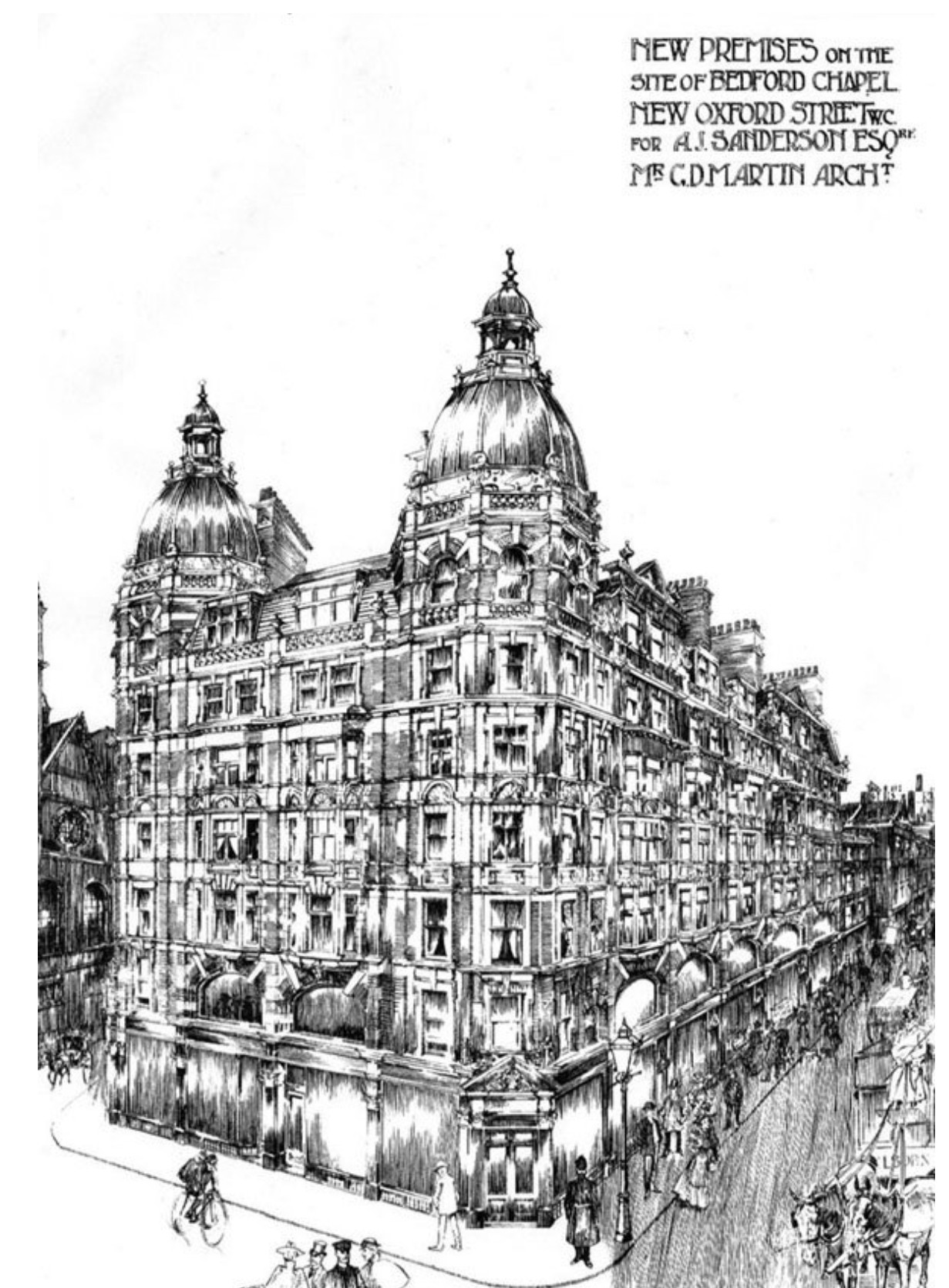 Artist's rendering of the soon to be built Albion House on the former premisis of the
Bedford Chapel. Note the unique domes as drawn in the map above.
Archiseek
Artist's rendering of the soon to be built Albion House on the former premisis of the
Bedford Chapel. Note the unique domes as drawn in the map above.
Archiseek
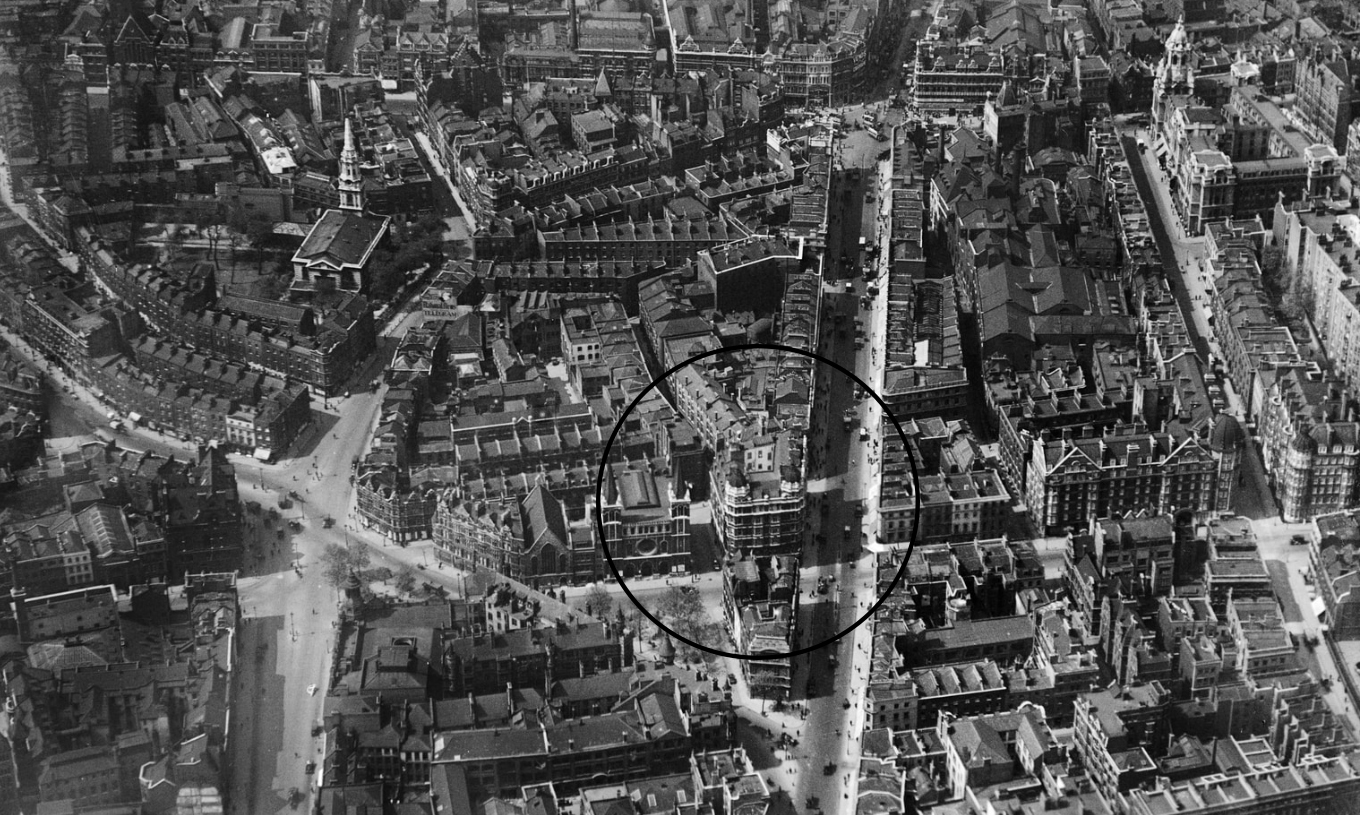 An aerial photo of Albion House, with its distinct domes, New Oxford Street,
Shaftesbury Avenue and Bloomsbury Chapel (1921).
Britain from Above
An aerial photo of Albion House, with its distinct domes, New Oxford Street,
Shaftesbury Avenue and Bloomsbury Chapel (1921).
Britain from Above
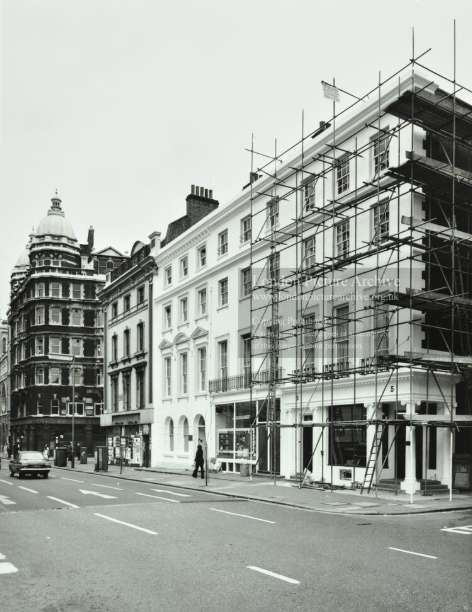 The Albion House and its domes are visible from Bloomsbury Street in this 1974 photo.
The photo caption states, "In the background, number 55 New Oxford Street can be seen, a six-storey
building with domes and dormers. This building has also since been refurbished and the domes no longer exist."
London Picture Archive
The Albion House and its domes are visible from Bloomsbury Street in this 1974 photo.
The photo caption states, "In the background, number 55 New Oxford Street can be seen, a six-storey
building with domes and dormers. This building has also since been refurbished and the domes no longer exist."
London Picture Archive
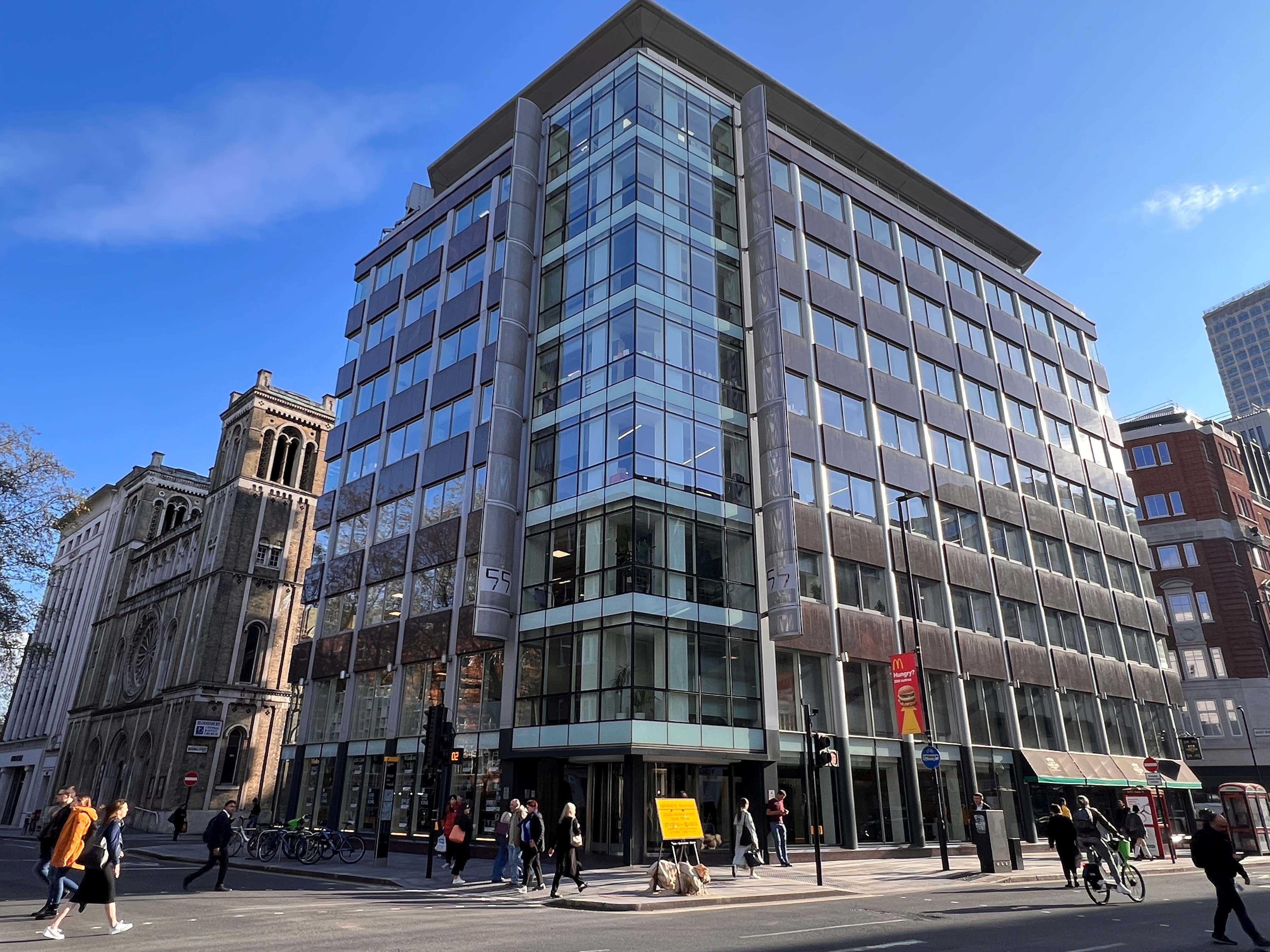 The modern glass building that replaced the original Albion House with a glimpse of Bloombury
Chapel behind it. P Marlin 2023
The modern glass building that replaced the original Albion House with a glimpse of Bloombury
Chapel behind it. P Marlin 2023
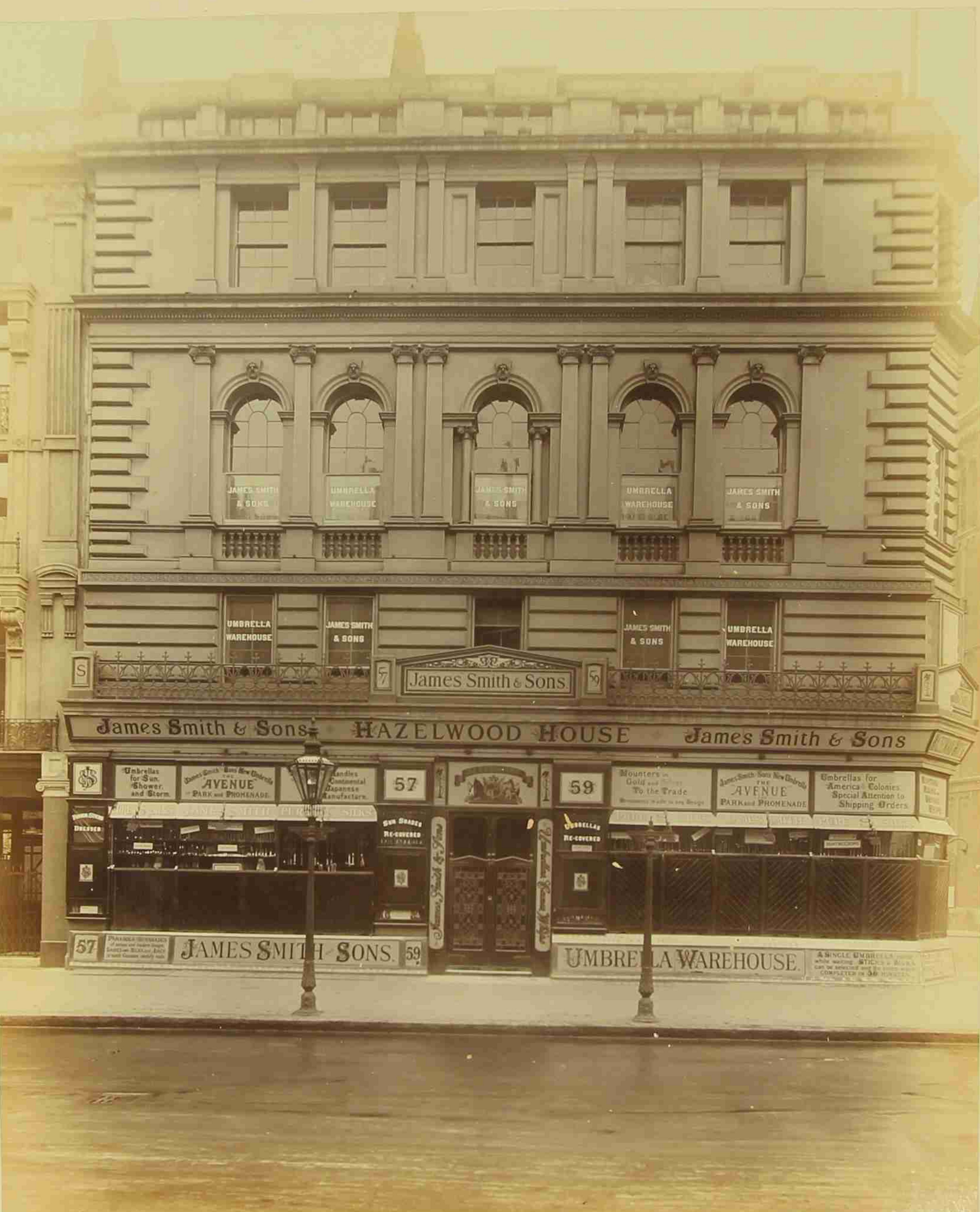 The James Smith & Sons Umbrella Warehouse, located across from Albion House,
has stood the test of time. (photo 1898) UK National Archives Images (licensed)
The James Smith & Sons Umbrella Warehouse, located across from Albion House,
has stood the test of time. (photo 1898) UK National Archives Images (licensed)
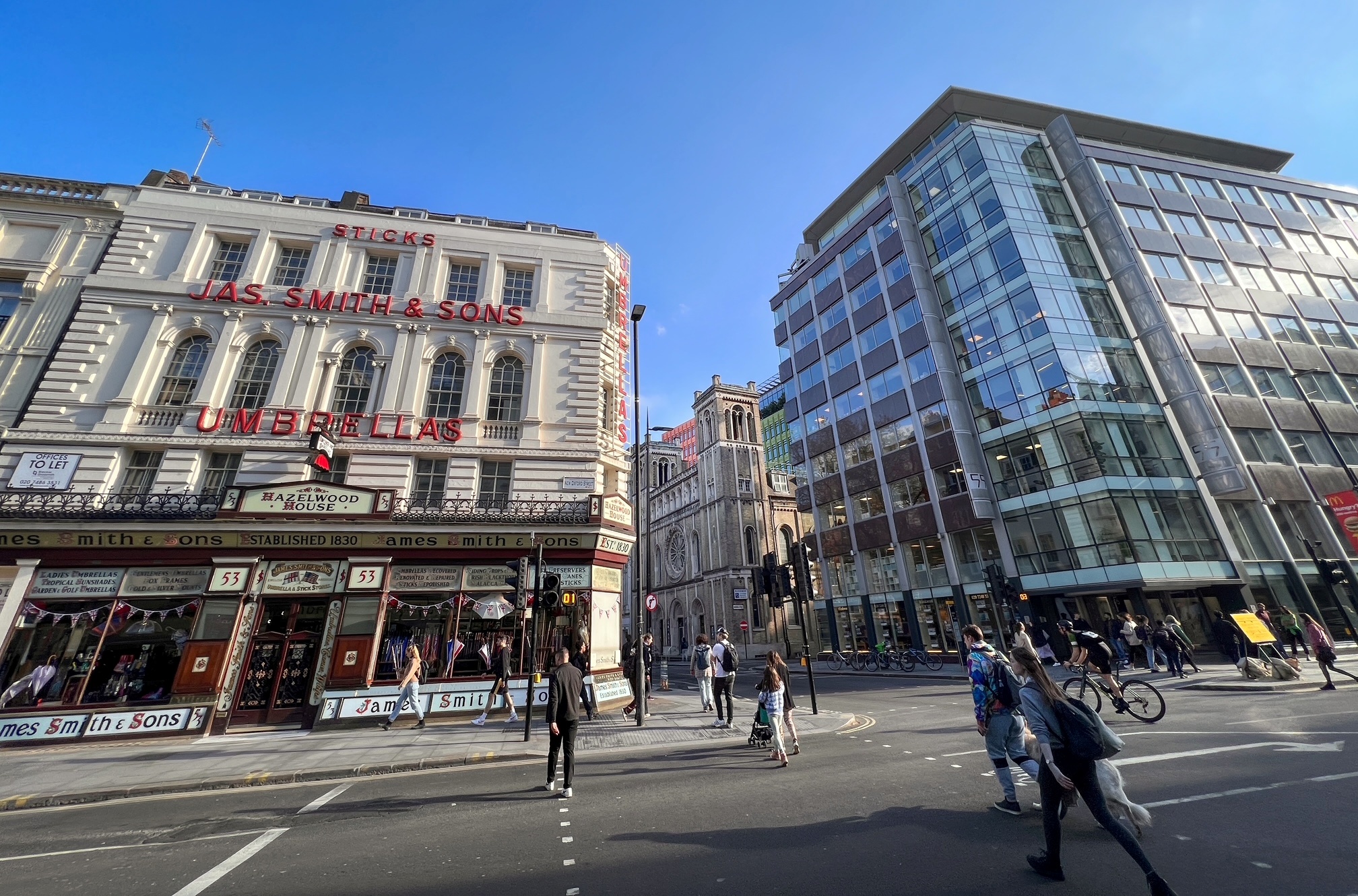 The intersection of New Oxford Street and Shaftesbury Avenue
offers a present-day view of the modern Albion House, the historic Bloomsbury Chapel, and the James
Smith & Sons umbrella shop, the latter two enduring landmarks that still stand from
the Crippen era. P Marlin 2023
The intersection of New Oxford Street and Shaftesbury Avenue
offers a present-day view of the modern Albion House, the historic Bloomsbury Chapel, and the James
Smith & Sons umbrella shop, the latter two enduring landmarks that still stand from
the Crippen era. P Marlin 2023
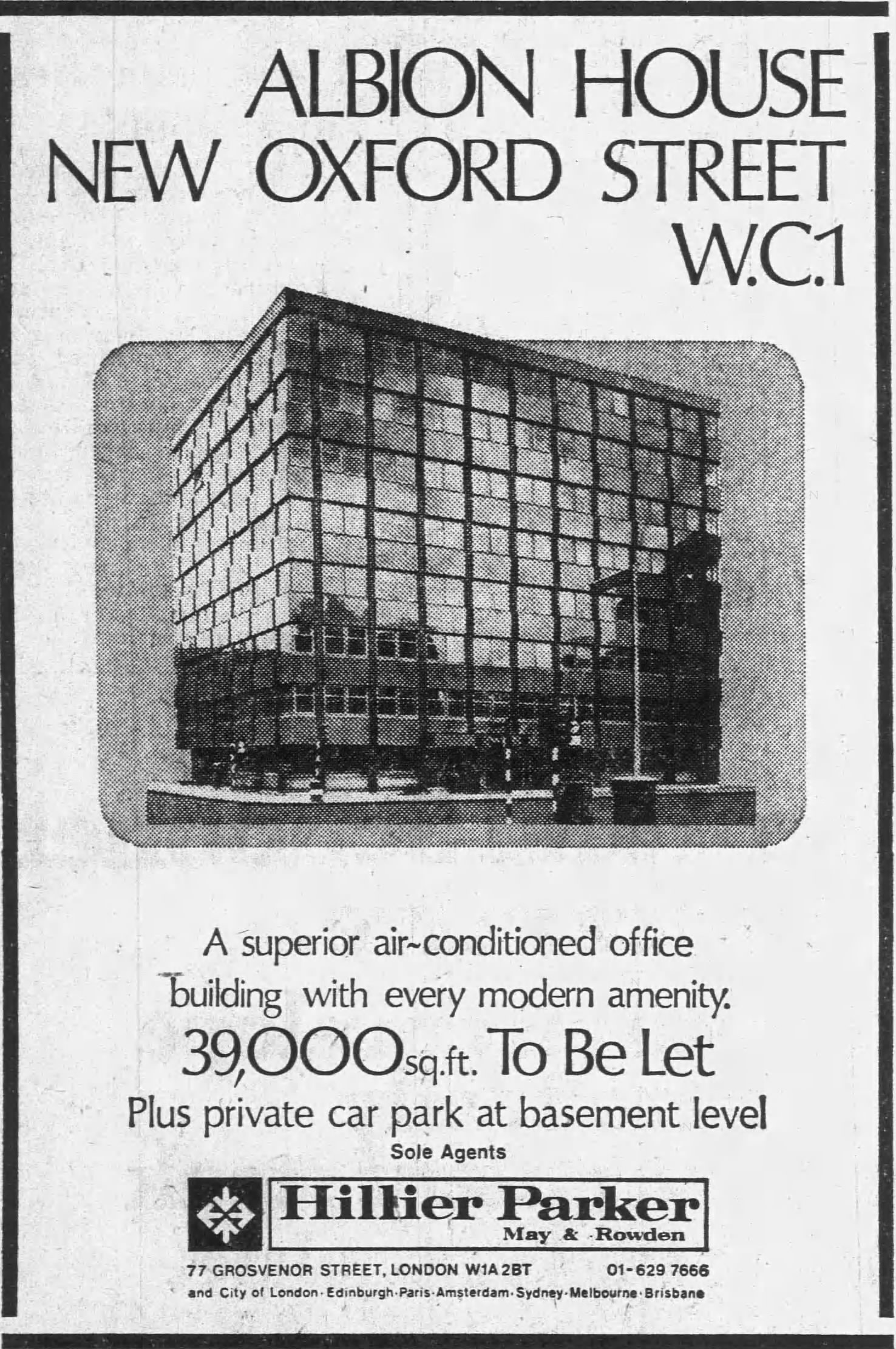 The new Albion House as advertised in The Daily Telegraph on May 24, 1977.
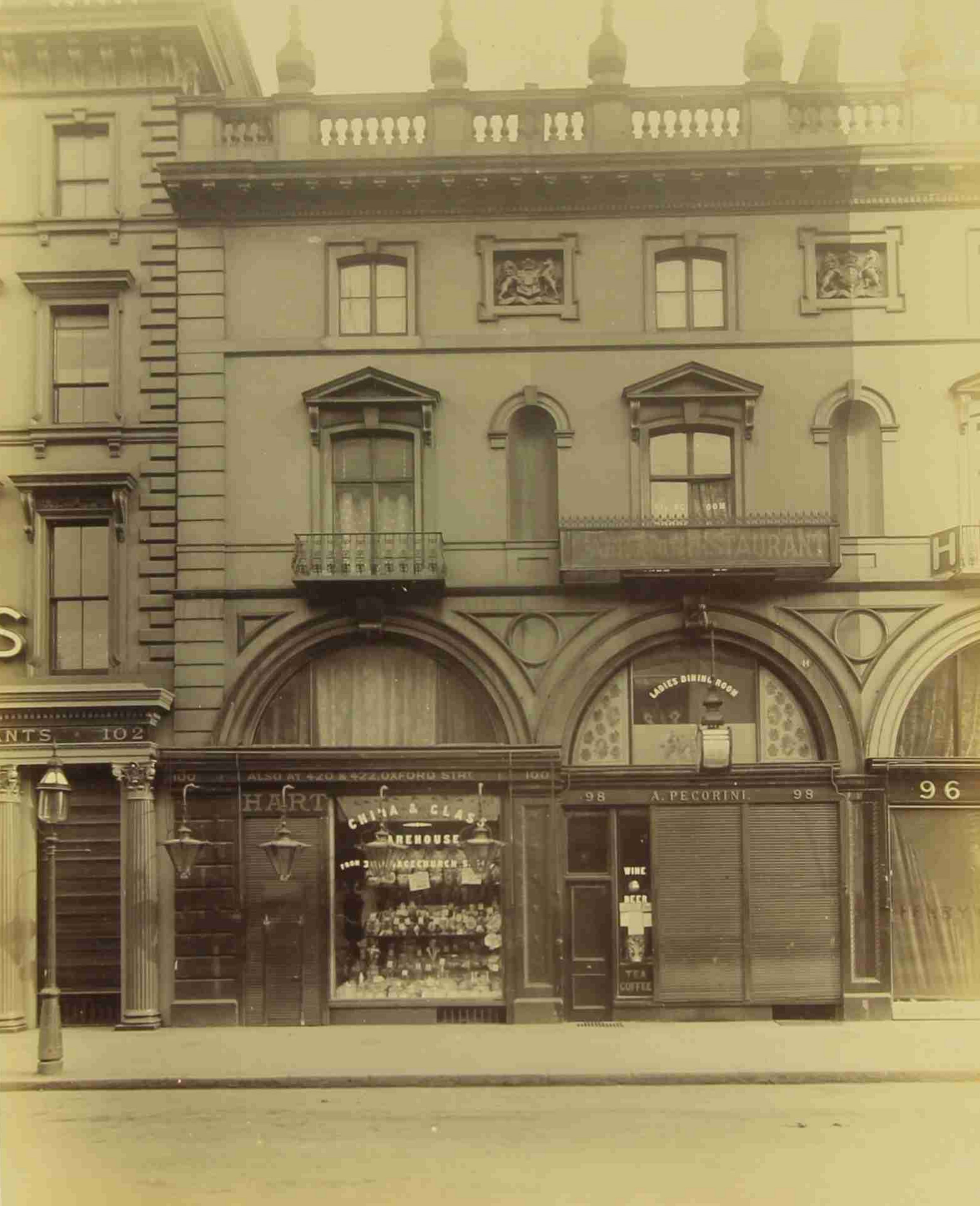 Though speculative, Inspector Dew’s lunch with Crippen may have occurred at A. Pecorini Italian Restaurant
(photo 1896). The restaurant was located at 98 New Oxford Street, adjacent to 102 and 108 New Oxford
Street (shown in the next two photos). UK National Archives Images (licensed)
Though speculative, Inspector Dew’s lunch with Crippen may have occurred at A. Pecorini Italian Restaurant
(photo 1896). The restaurant was located at 98 New Oxford Street, adjacent to 102 and 108 New Oxford
Street (shown in the next two photos). UK National Archives Images (licensed)
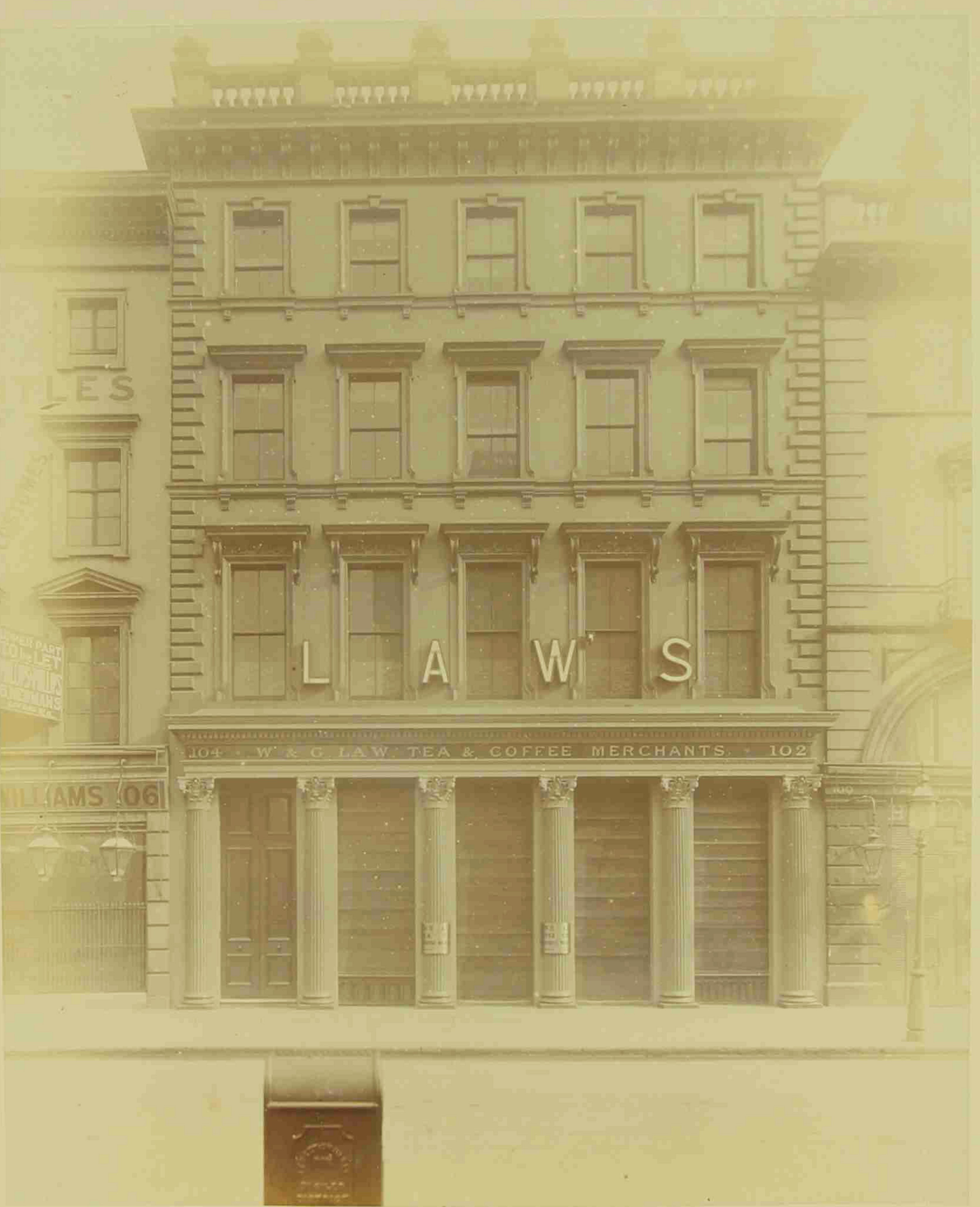 For a time Aural Clinic was located at 102 New Oxford Street ( photo 1896). UK National Archives Images (licensed)
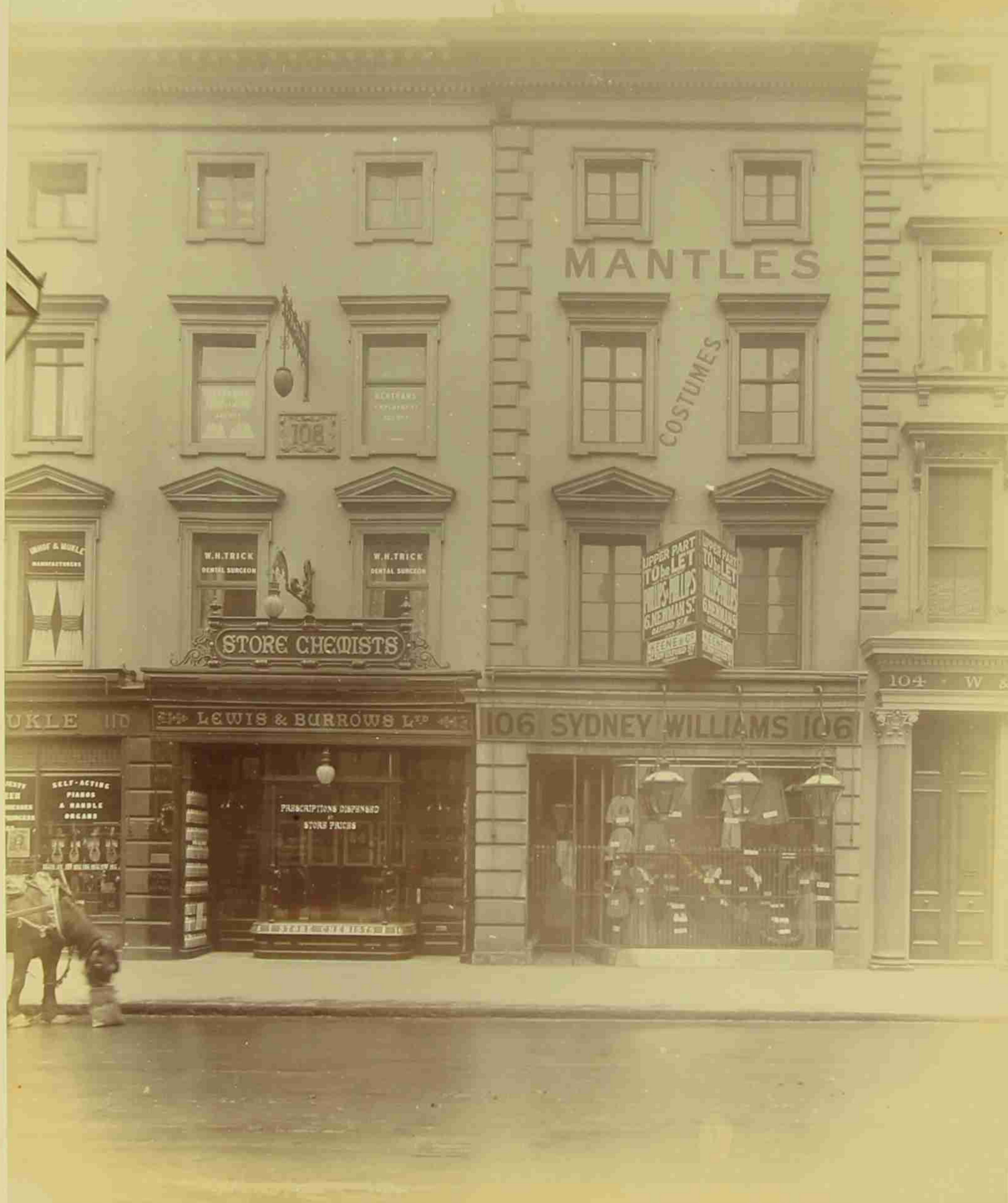 Lewis & Burrows Chemists at 108 Oxford Street (photo 1896). UK National Archives Images (licensed)
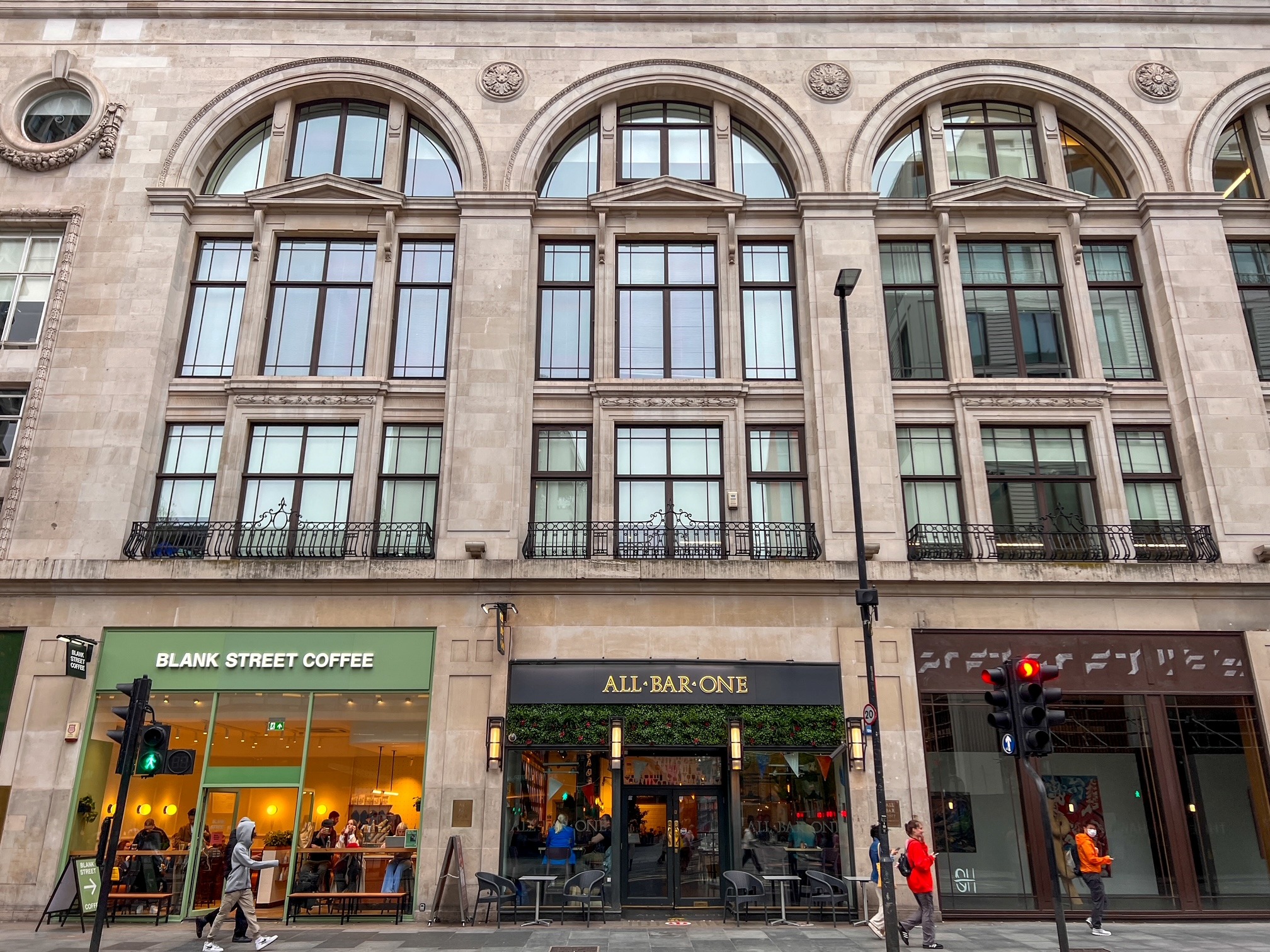 This modern building replaced what was originally 102 New Oxford Street (Aural Clinic)
and 108 New Oxford Street (Lewis & Burrows, Chemists). P Marlin 2023
This modern building replaced what was originally 102 New Oxford Street (Aural Clinic)
and 108 New Oxford Street (Lewis & Burrows, Chemists). P Marlin 2023
Following Crippen and Ethel’s abrupt departure from Albion House, their desperate flight across the Atlantic to evade police scrutiny sparked one of the most sensational manhunts of the early twentieth century. What began as an escape turned into a global spectacle, a chase followed in real time across continents, thanks to the new marvel of the Marconi wireless. When Detective Chief Inspector Walter Dew finally apprehended the couple in Quebec, the news flashed across the world with the same technology that had sealed their fate.
When the pair arrived back in London, they were taken directly to Bow Street Police Station, the epicenter of British justice for nearly two centuries. Standing just off Covent Garden, Bow Street was no ordinary police station. Since its founding in the 1740s by magistrate Henry Fielding, who, along with his half-brother Sir John Fielding, created the Bow Street Runners, it had been synonymous with law, order, and some of the city’s most infamous hearings. The building that greeted Crippen and Ethel in 1910 had been erected in 1881, housing both police cells and the magistrates’ court, a place where London’s drama and disgrace were paraded daily.
As their carriage pulled up to Bow Street that late August afternoon, the crowd was already waiting. Shouting and jeering at the small, pale figures emerging under police escort, the self-contained Crippen must have felt the roar of the mob like a physical weight. Inside Bow Street, the two were charged and kept under constant guard, not in the common cells, but in private rooms within the station, away from the public gaze.
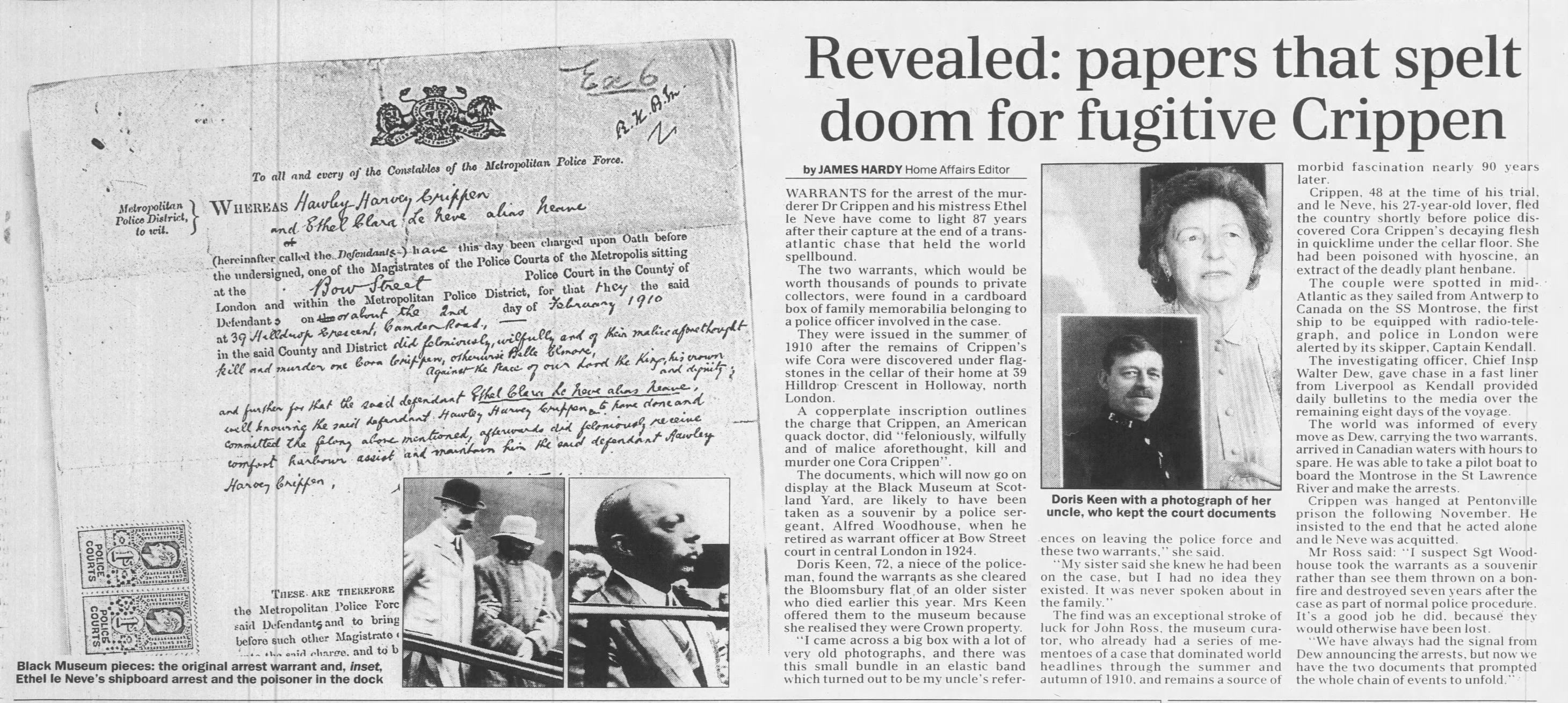
 A photo of the original Bow Street charge papers printed in the Sunday Telegraph May, 25 1997.
The original warrant papers were found in a family memorabilia box of one of the descendants of
Bow Street sargeant Alfred Woodhouse, who had taken the papers. Read full article
A photo of the original Bow Street charge papers printed in the Sunday Telegraph May, 25 1997.
The original warrant papers were found in a family memorabilia box of one of the descendants of
Bow Street sargeant Alfred Woodhouse, who had taken the papers. Read full article
A few days later, on August 29, 1910, they were brought before the magistrate in the small courtroom on the ground floor of Bow Street. The setting was intimate, yet heavy with history. The infamous dock, a high, three-sided iron enclosure with a wooden base, stood at the center of the room like a stage. For generations, it had confined thieves, rebels, and murderers; it was now Crippen’s turn.
Crippen entered the dock first, composed and neatly dressed in a light grey frock coat with silk facings, matching trousers and waistcoat, and polished black button boots. He carried a soft grey hat, which he gently placed on the dock seat. Moments later, Ethel followed. Her face, hidden beneath a heavy blue veil, was described in the newspapers as “a strikingly pathetic figure.” Her slim white fingers clutched the iron rail before her, trembling slightly. From that small, confined space, the two listened as the charges of murder were read aloud, words that echoed off the panelled walls and sealed their fates.
After the brief hearing, both were remanded into custody. Crippen was taken to Brixton Prison; Ethel, charged only as an accessory, to Holloway Prison for women. Their paths diverged from that moment, his ending at the gallows of Pentonville Prison on November 23, 1910; hers in quiet obscurity after release.
Nearly a century later, in 2006, Bow Street Magistrates’ Court finally closed its doors, bringing an end to more than two hundred years of London’s legal history. The famous Bow Street dock, where Crippen and Ethel stood side by side before the magistrate, was preserved and put on display at the National Justice Museum in Nottingham (along with other Crippen items). The Bow Street building was restored as the NoMad Hotel London.
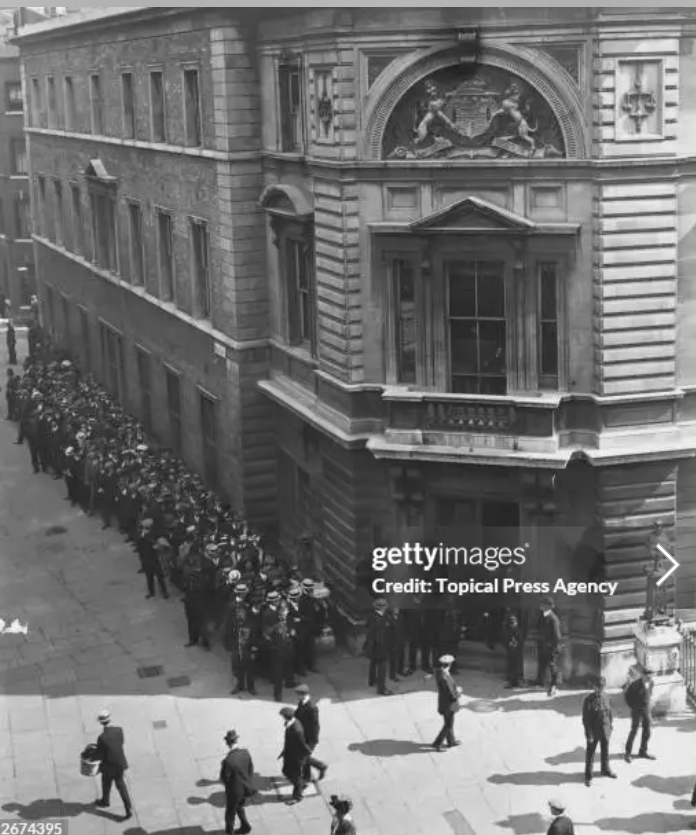 People await entry into Crippen and Ethel's Bow Street hearing on
August 29, 1910. Gettys Images
People await entry into Crippen and Ethel's Bow Street hearing on
August 29, 1910. Gettys Images
 Today, the original Bow Street Station is now a hotel. P Marlin 2023
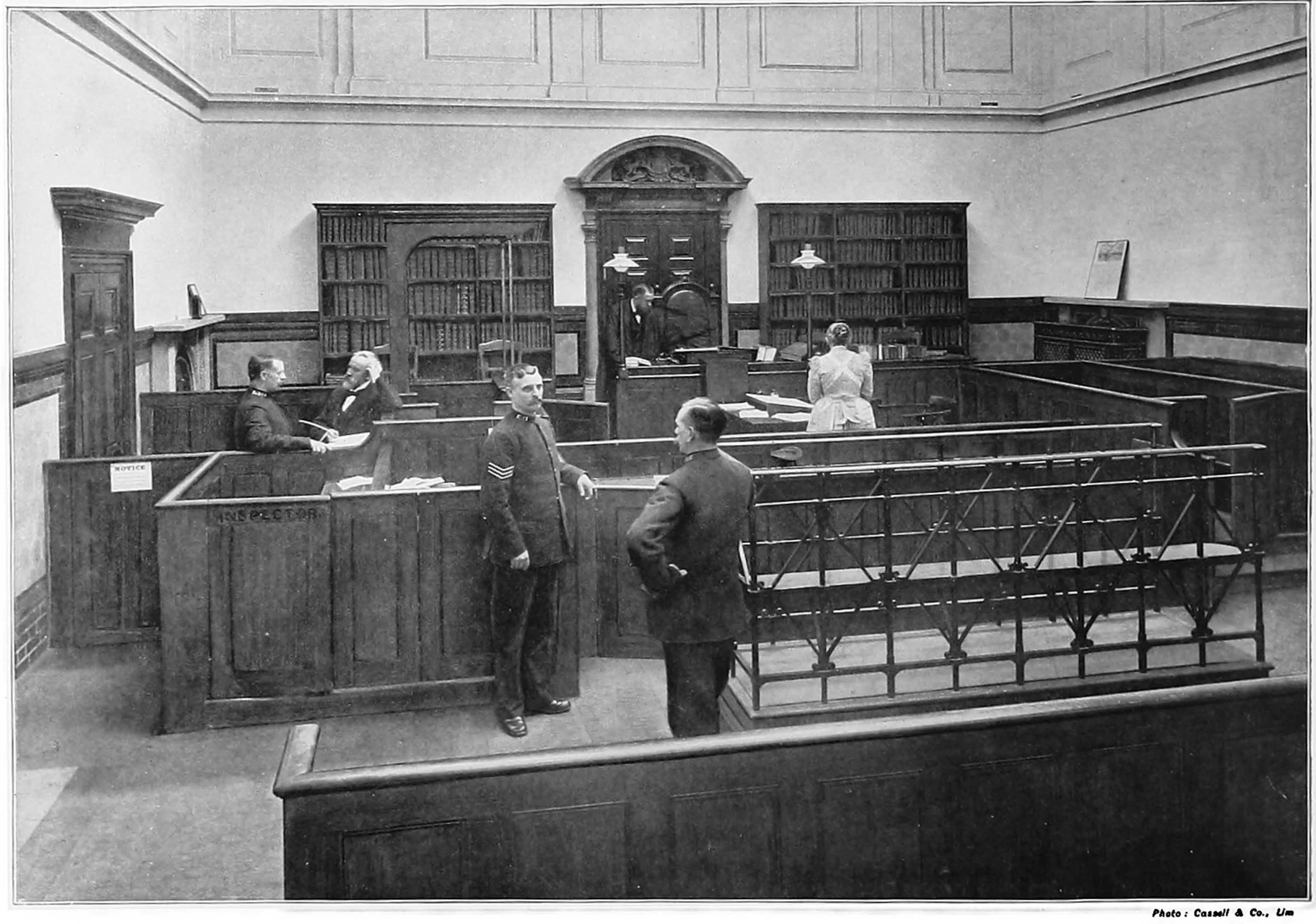 The Bow Street dock in the magistrates' courtroom in 1895.
A view of
magistrates' courtroom in 2006 when it closed for the final time. Wikipedia
The Bow Street dock in the magistrates' courtroom in 1895.
A view of
magistrates' courtroom in 2006 when it closed for the final time. Wikipedia
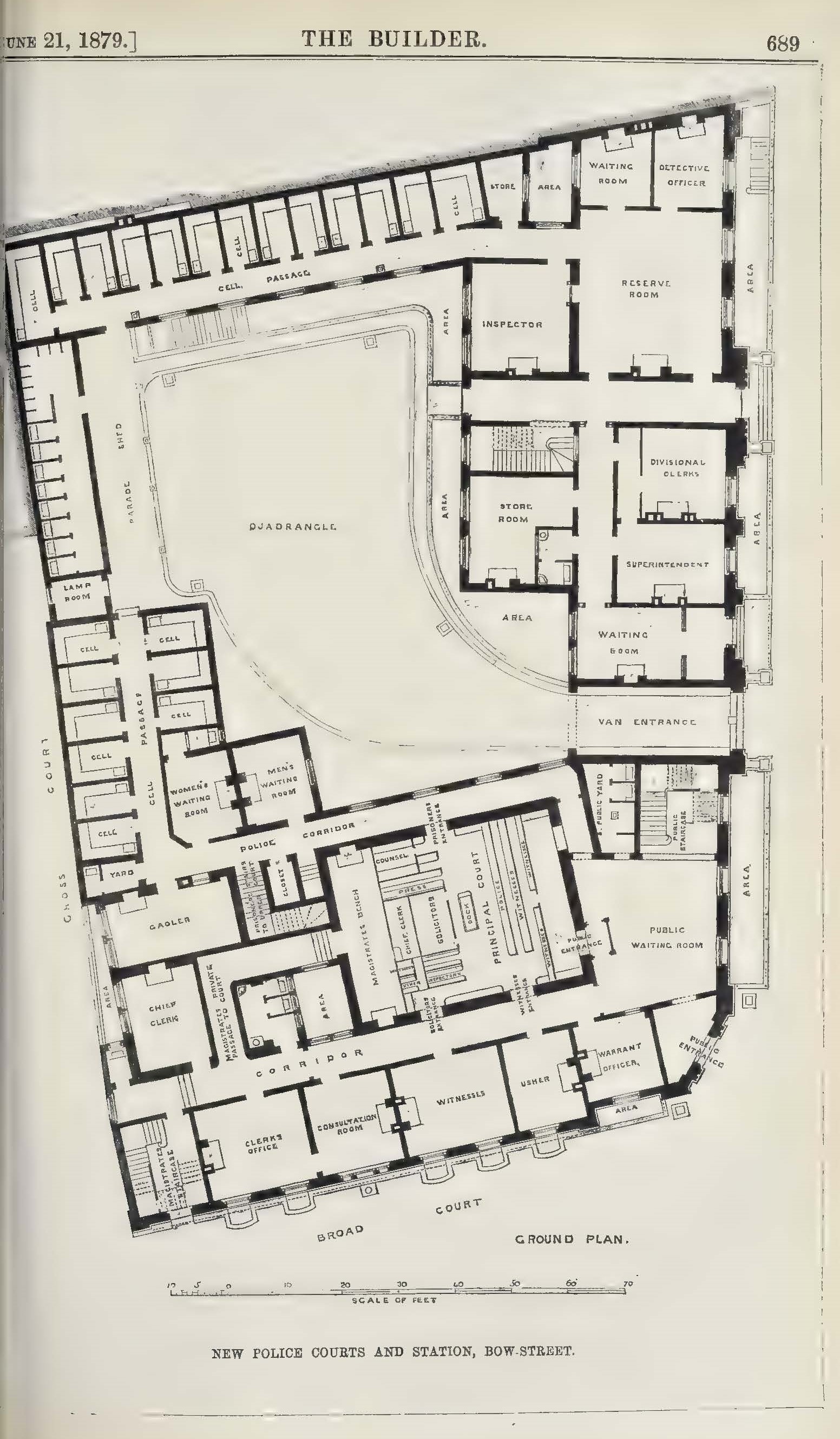 The Ground Plan of the New Police Courts and Station, Bow Street (1879). The drawing
shows the layout of the Bow Street Station including the courtroom with the dock.
The Builder Volume 37 1842 Internet Archive
The Ground Plan of the New Police Courts and Station, Bow Street (1879). The drawing
shows the layout of the Bow Street Station including the courtroom with the dock.
The Builder Volume 37 1842 Internet Archive
The National Justice Museum in Nottingham currently displays the original dock from Bow Street Magistrates’ Court, the very enclosure in which Crippen and Ethel were held and heard the evidence in 1910. It anchors the story in physical space: you can see how the accused stood behind the iron rail, facing the bench and the world beyond. In the Crime Gallery you’ll also find the dedicated exhibition exploring the work of Sir Bernard Spilsbury, the pathologist whose testimony played a pivotal role in the Crippen trial.
Among the museum’s remarkable artifacts is one of the microscope slides on which Spilsbury based his opinion. He claimed that a small fragment of skin, showing an abdominal scar, matched the surgery that Cora had undergone, thereby identifying the remains found under Crippen’s London house as hers. This scar became a cornerstone of the prosecution’s case. Spilsbury’s confident assertion that this scar was consistent with her medical history, carried great weight in the courtroom.
By linking the preserved dock, the slide, and the Spilsbury exhibit, the museum offers visitors a tangible journey through the case: from the courtroom enclosure where Crippen stood, to the microscopic forensic clue that helped seal the verdict.
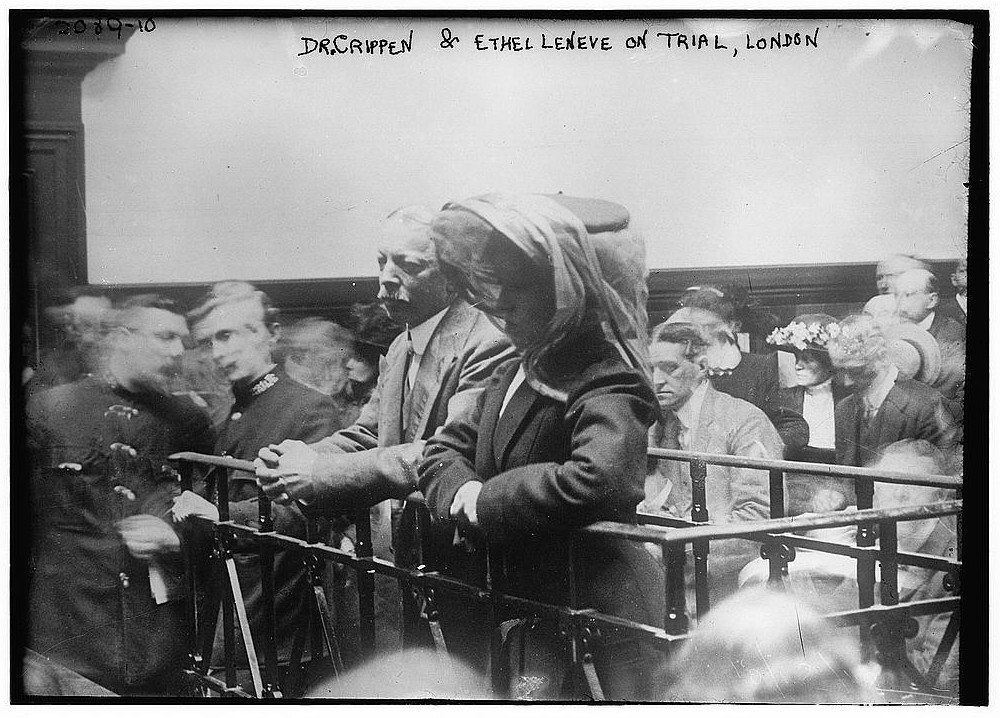 Crippen and Ethel in the Bow Street Dock. Library of Congress
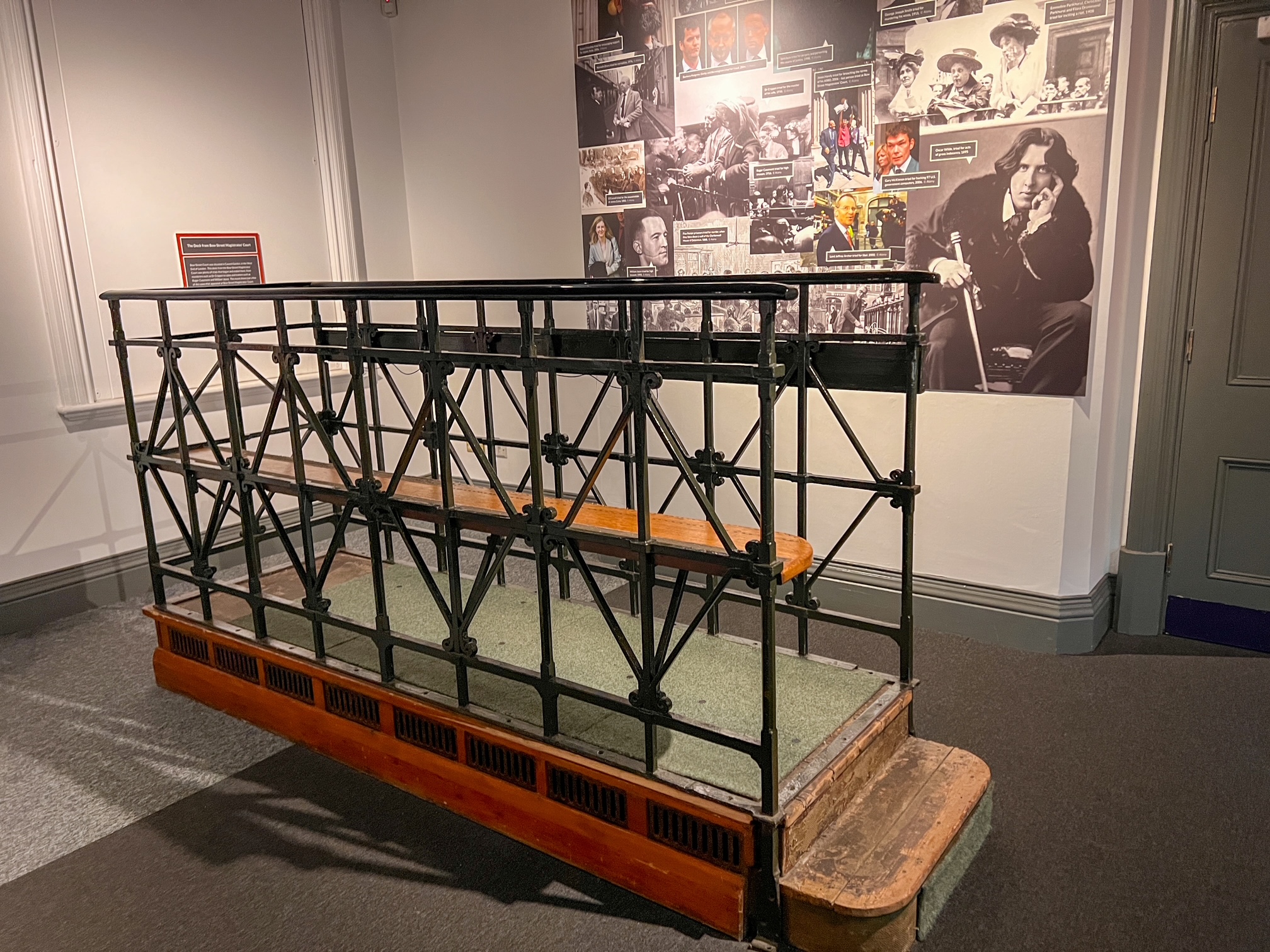 The original Bow Street dock on display at the National Justice Museum in Nottingham. P Marlin 2023
 The original Bow Street dock on display at the National Justice Museum in Nottingham. P Marlin 2023
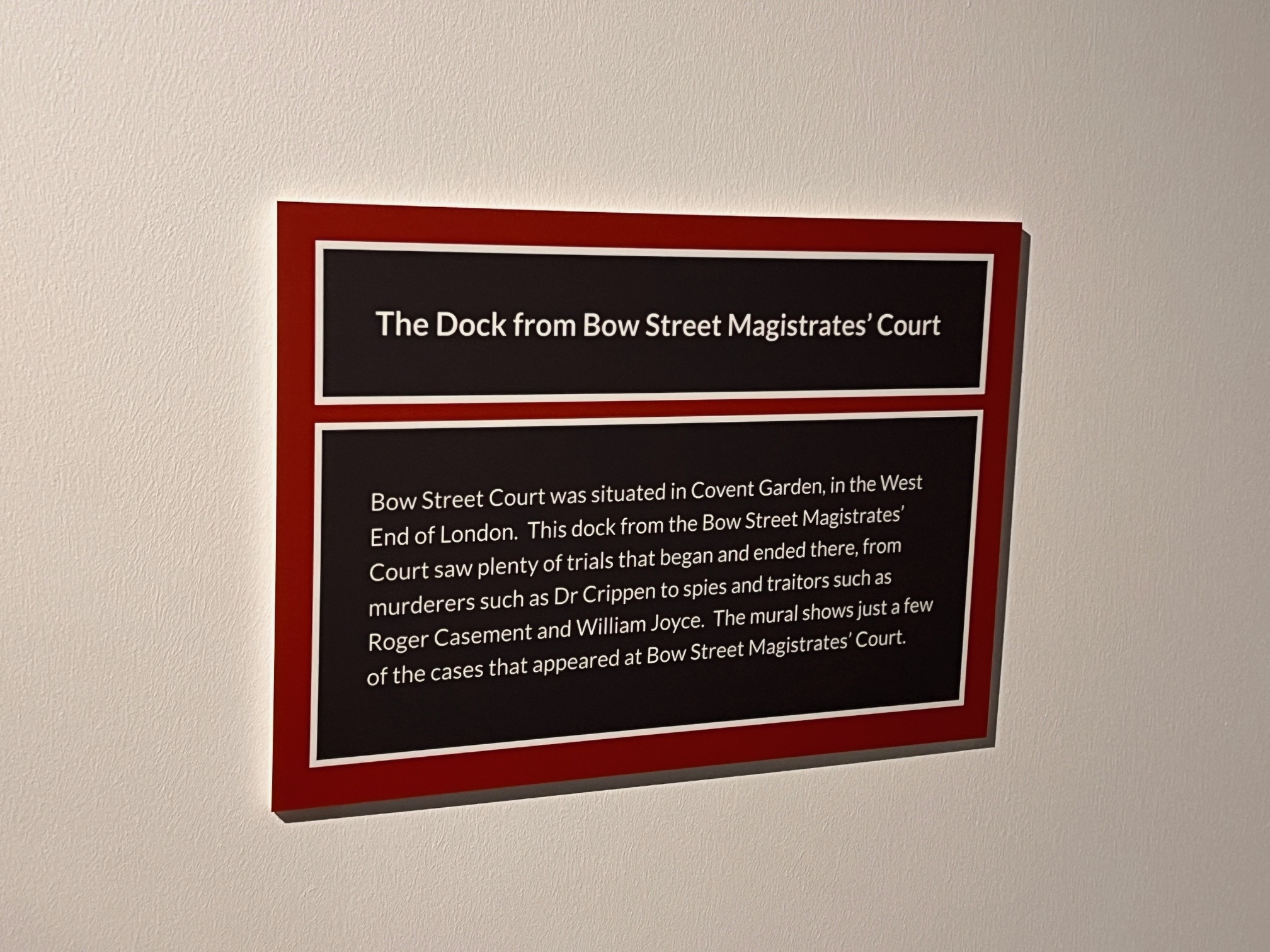 National Justice Museum, Nottingham.
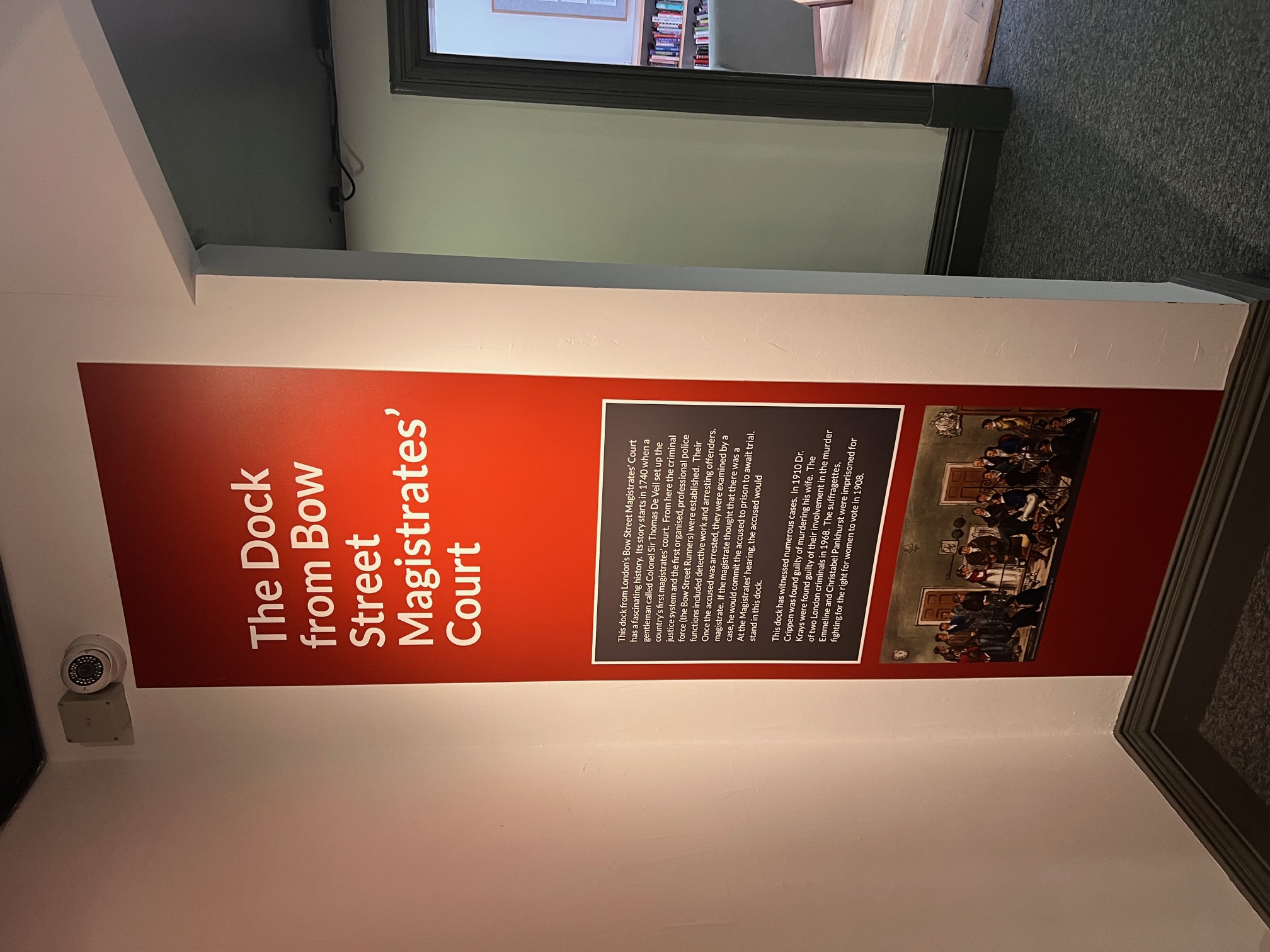 National Justice Museum, Nottingham.
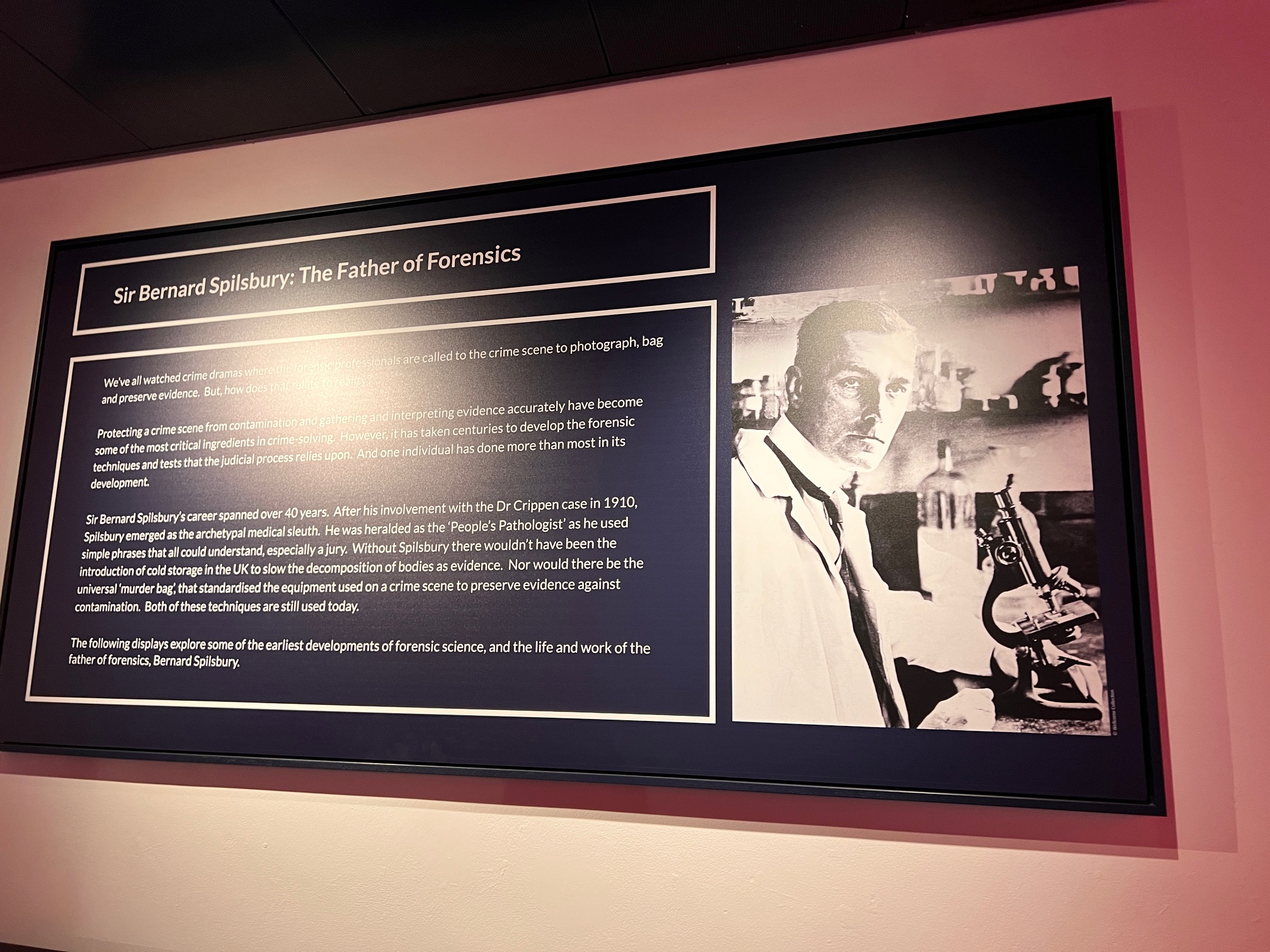 National Justice Museum, Nottingham. P Marlin 2023
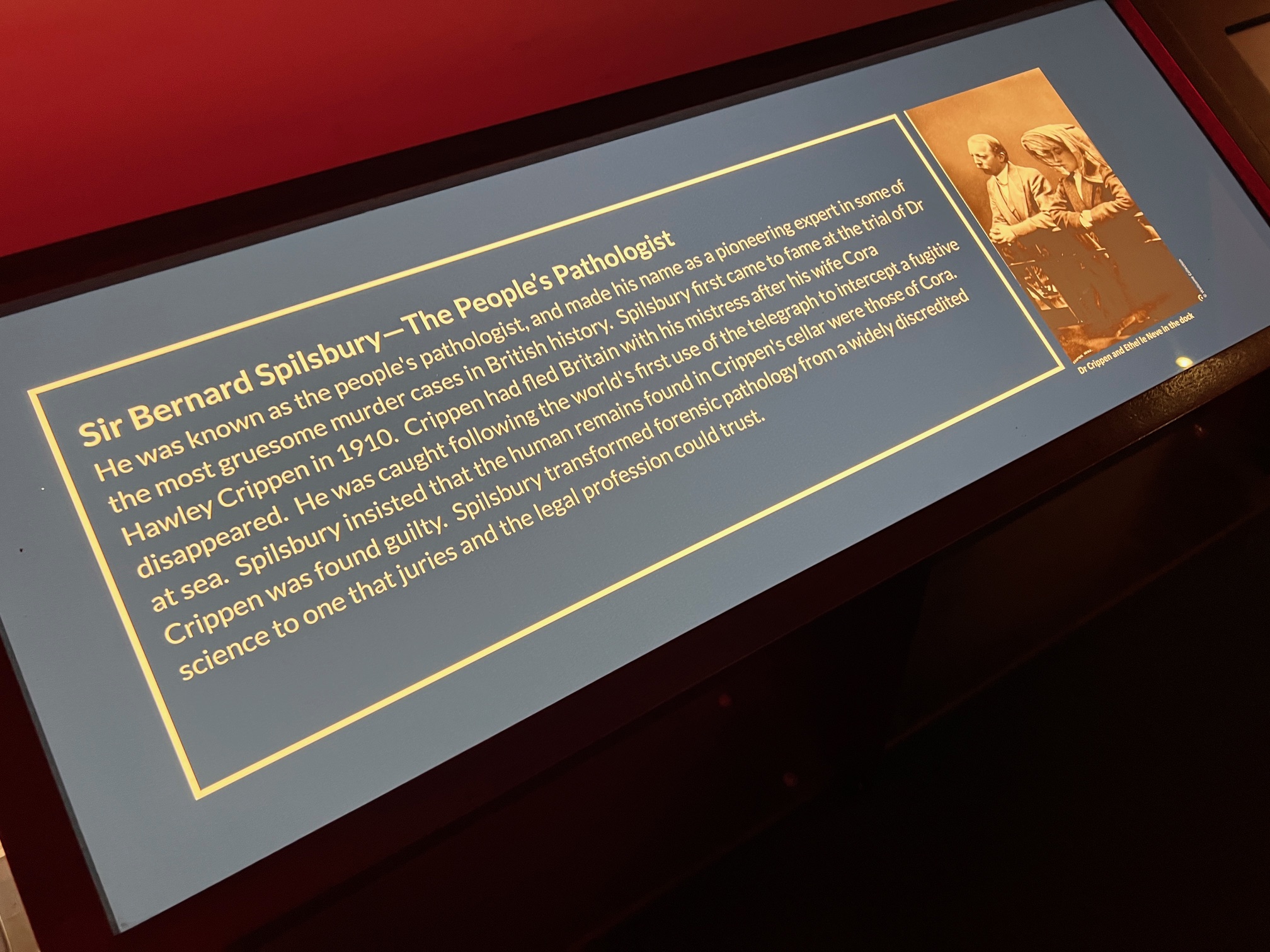 National Justice Museum, Nottingham. P Marlin 2023
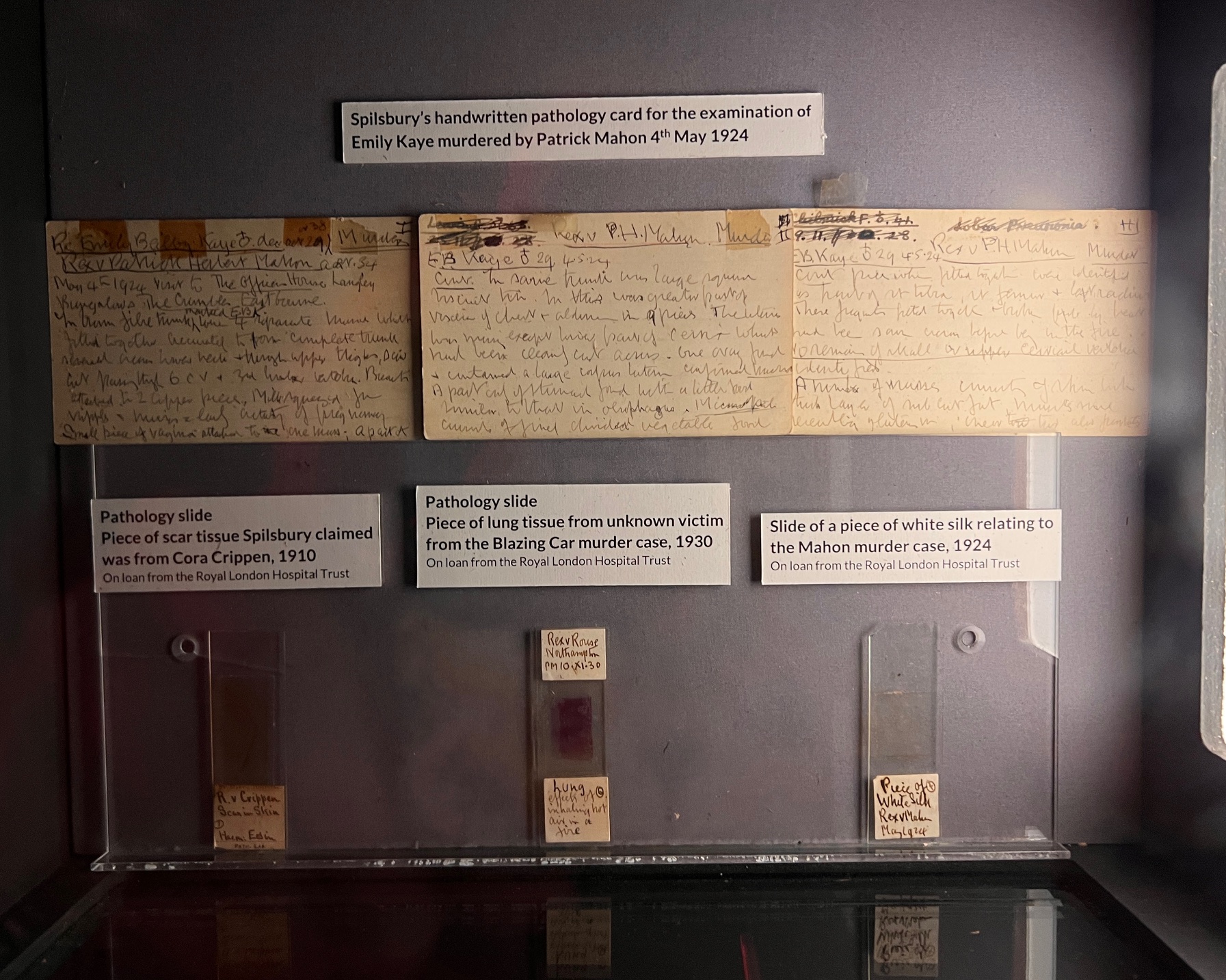 National Justice Museum, Nottingham. P Marlin 2023
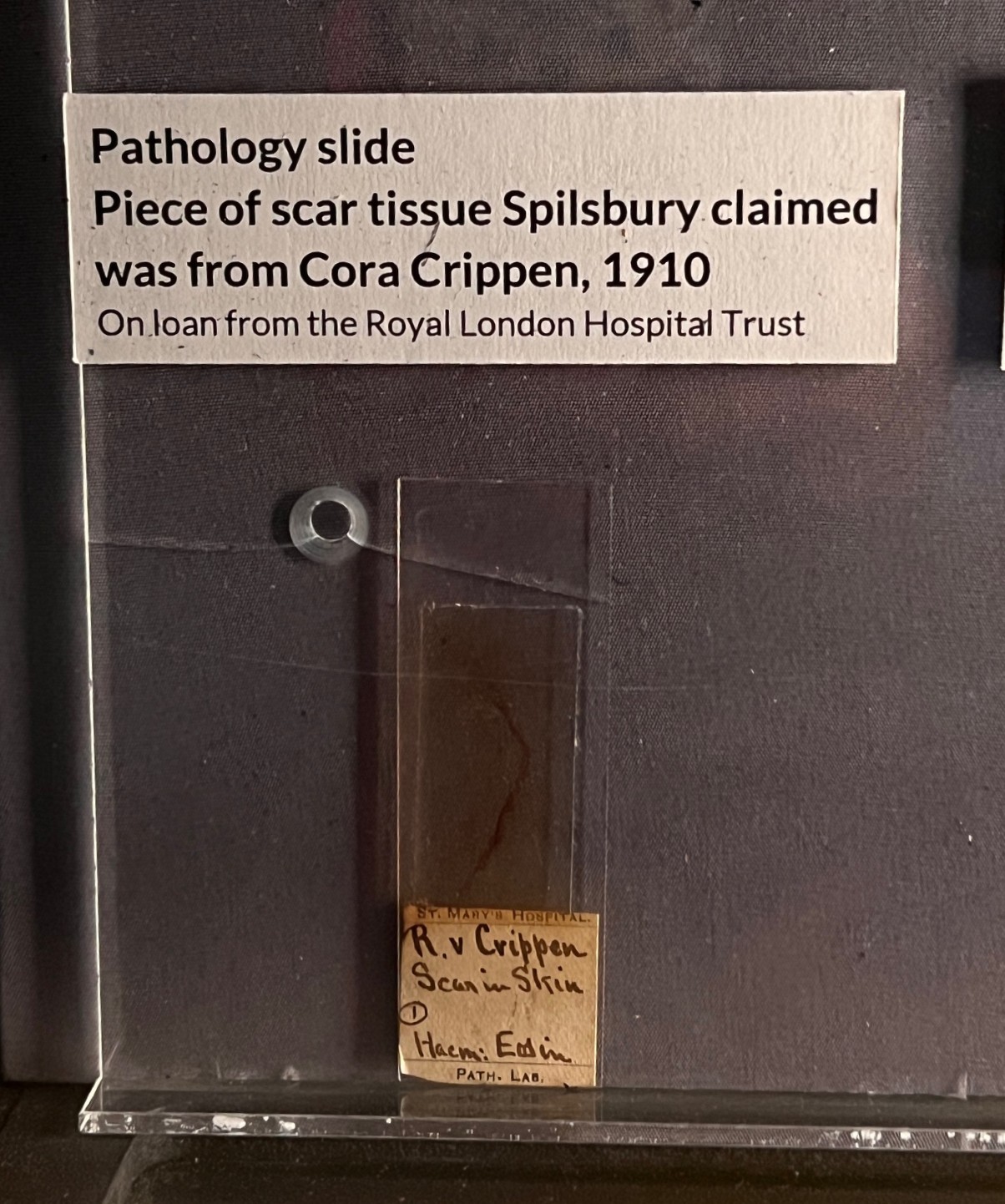 A pathology slide displaying Cora Crippen’s remains, with her scar clearly visible. P Marlin 2023
On November 23, 1910, within the cold stone walls of Pentonville Prison, Hawley Harvey Crippen met his fate. As the Edwardian era faded, the quiet, soft-spoken doctor from rural Michigan, who once dreamed of success and belonging, was hanged for murder, far from the country that had shaped him. To the end, Crippen's calm demeanor remained. The gruesome act of dismembering his wife, the constant charade before the music hall circle and investigators, and the clandestine affair he continued to nurture likely brewed a deep and growing turmoil within Crippen’s quiet exterior.
In his final letters, Crippen urged Ethel not to keep the Le Neve name. With quiet persistence, he asked that she instead take his own first name, Hawley, or his middle name, Harvey, as her surname. When Ethel married Stanley Smith in 1915, she did so under the name Ethel Harvey.
In the end, history would have its own ironies. Winston Church, the Home Secretary who denied Crippen’s appeal, was descended, through his American mother, Jennie Jerome, from patriarch Joseph Hawley. The same Joseph Hawley that Crippen was descended from through his great-great grandmother Currence Hawley.
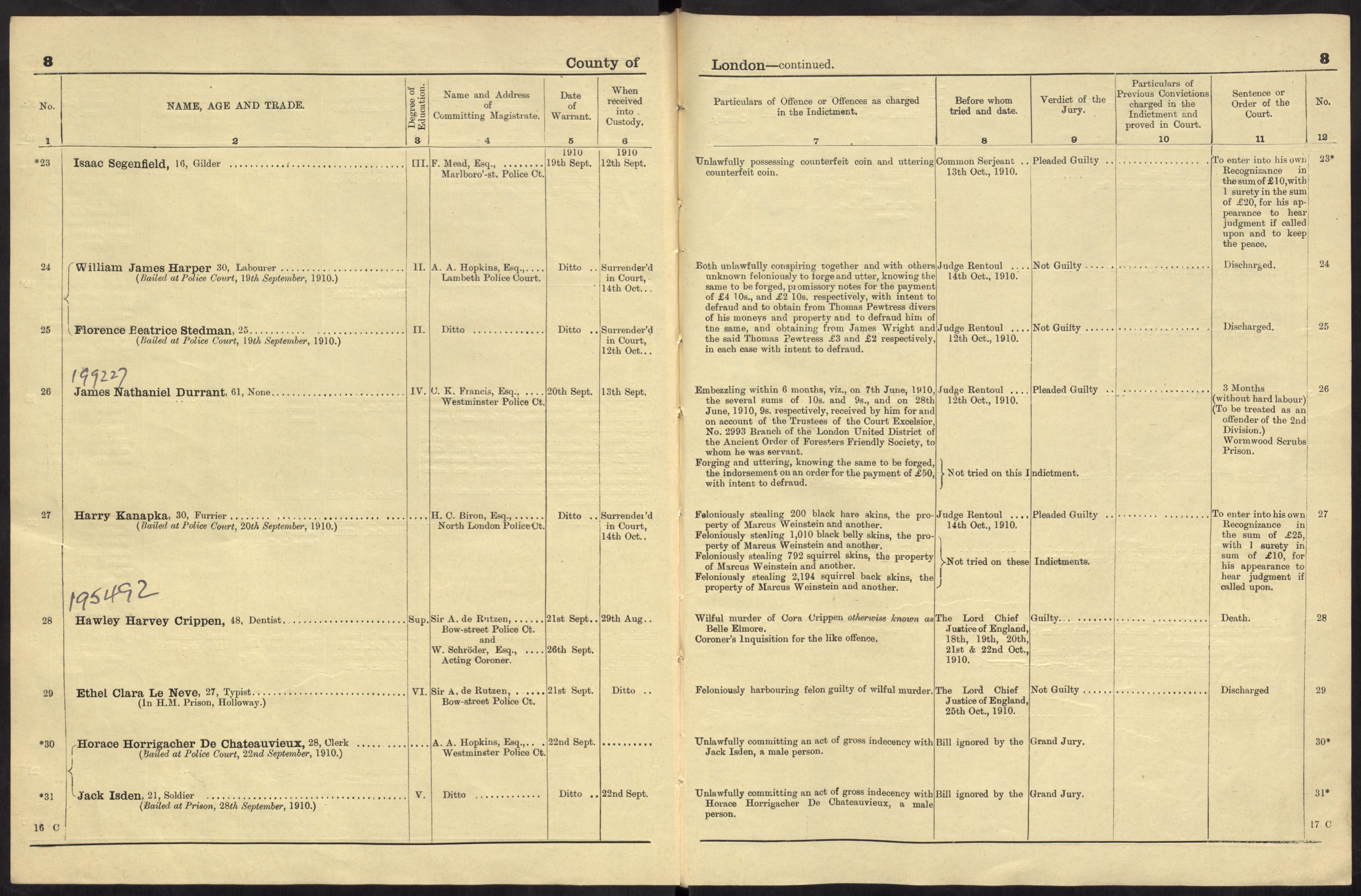 London's record of convicts.
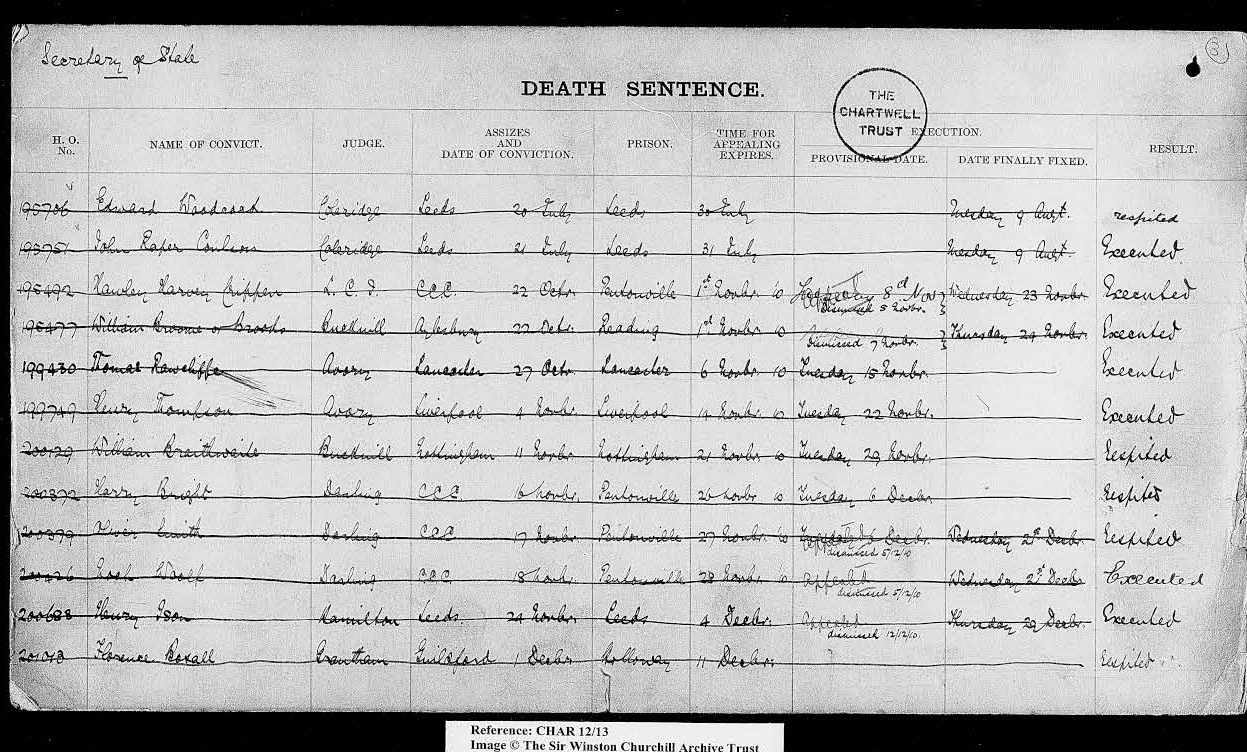 From the records of the Home Secretary, Winston Churchill.
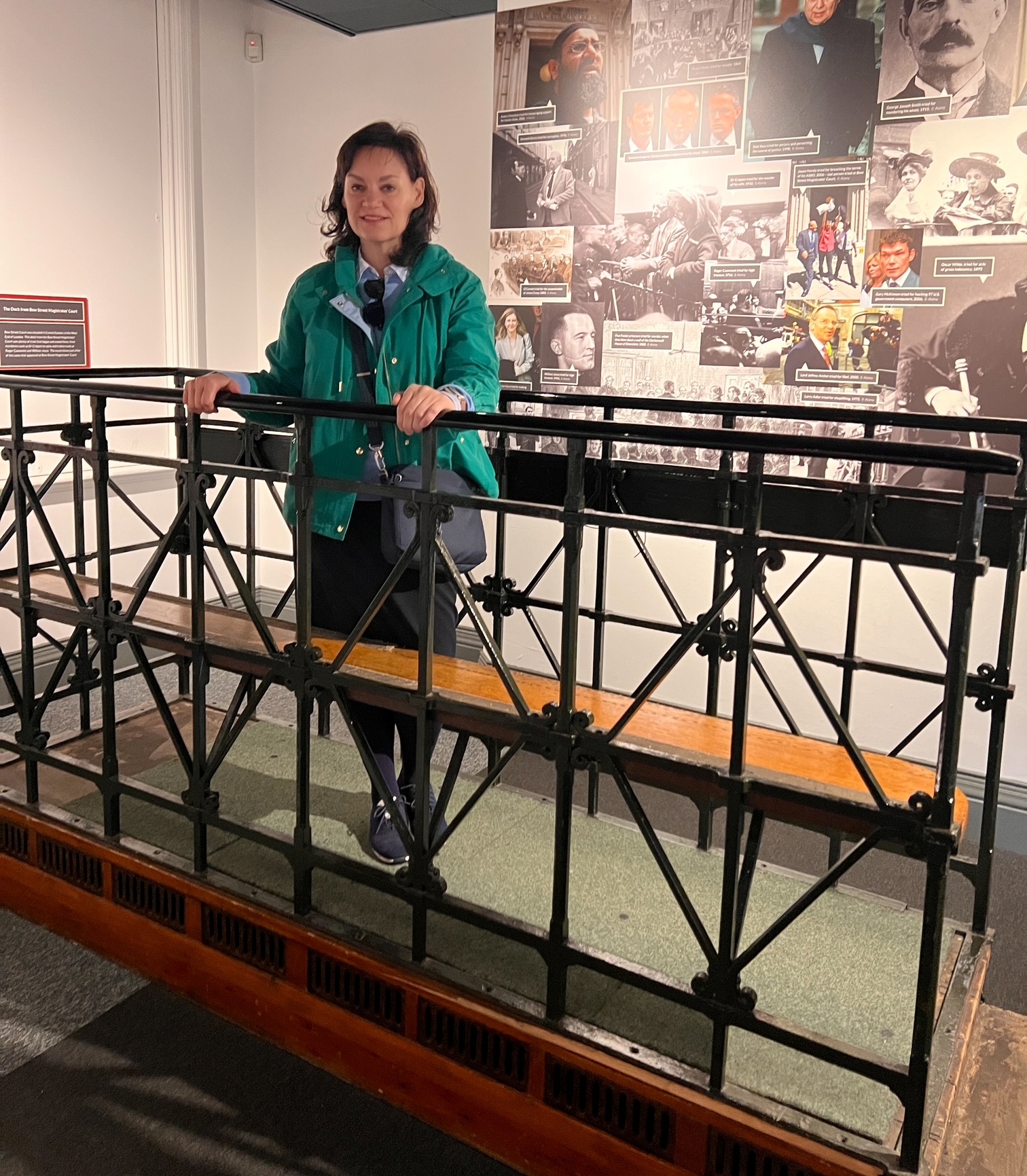 Me in the dock.